
Blue Eyes Lemon Bushfish (Ctenopoma acutirostre)
Ctenopoma acutirostre
Also known as: Spotted Climbing Perch, Leopard Bushfish, Spotted Ctenopoma, Spotted Bushfish
Origin: Central Africa (Congo River basin)
Water Parameters
Quick Stats
- Max Size
- 15 cm
- Min Tank
- 150 L
- Lifespan
- 10
- Swimming Level
- bottom
- Schooling
- No
- Diet
- carnivore
- Temperament
- semi-aggressive
About
Ctenopoma acutirostre, the Spotted Bushfish or Leopard Bushfish, is a mesmerising and predatory labyrinth fish native to the Congo River basin in Central Africa. Unlike the more commonly kept gouramis, Ctenopoma species are true predators that use a sit-and-wait ambush strategy to capture prey — drifting motionless among leaf litter before striking with surprising speed.
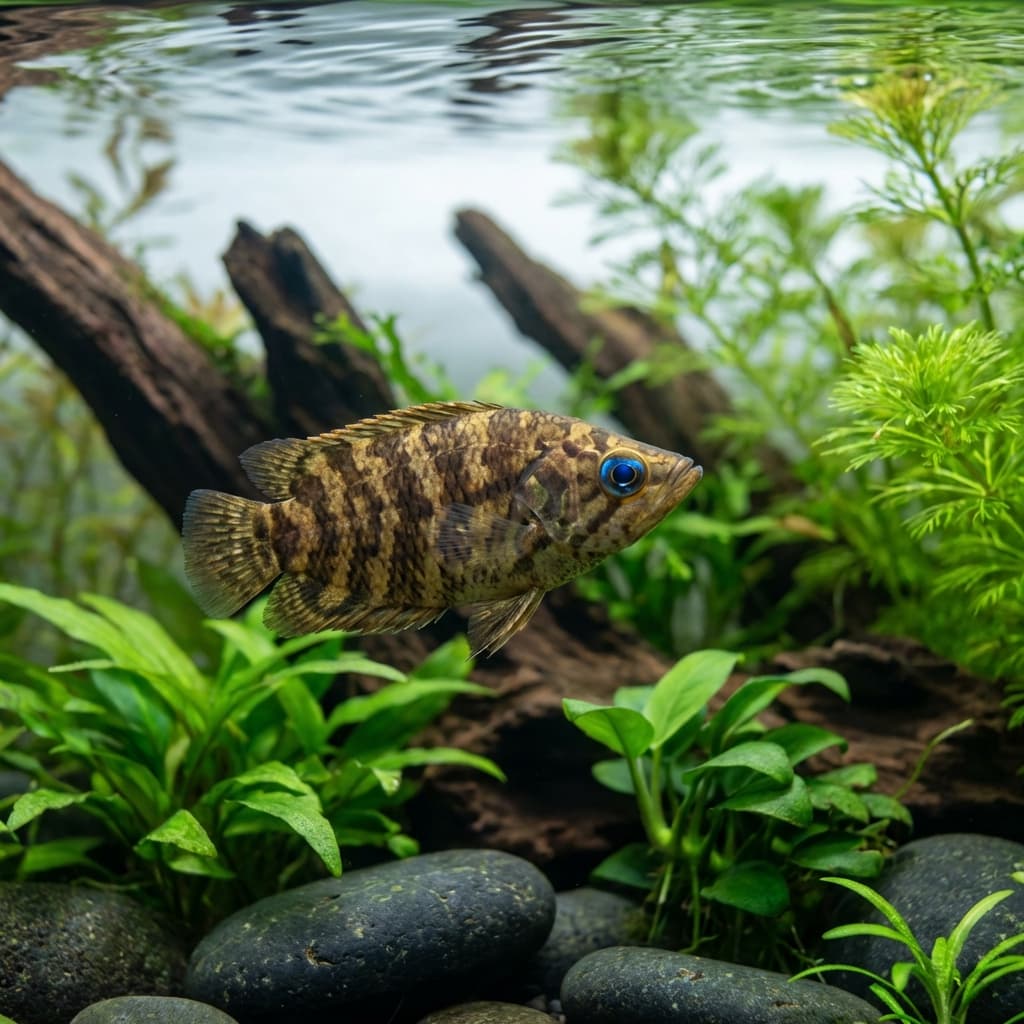
The camouflage colouration is spectacular: a pale cream to yellow base covered in irregular dark brown to black spots, creating a pattern remarkably similar to the spotted patterns found on big cats. A dark patch at the base of the tail serves as a 'false eye' that confuses prey and predators alike. This patterning makes the fish virtually invisible among dead leaves on the substrate.
As a labyrinth fish, C. acutirostre possesses the labyrinth organ that allows it to breathe atmospheric oxygen directly — it must always have surface access. Unlike many other labyrinth fish, it does not build bubble nests but is an open water spawner.
Despite its predatory nature, the Leopard Bushfish is a shy and reclusive species that rarely shows aggression toward fish too large to eat. It is best kept in a species tank or with other large, robust fish that cannot be swallowed. All small fish, shrimp, and invertebrates will eventually be eaten.
Care Guide
Tank Setup: A minimum 150-litre aquarium with ample hiding places: dense planting, driftwood tangles, caves, and broad-leaved plants like Amazon swords. Dim lighting or floating plants suit this species — it is naturally a dim-light ambush predator. Keep water well-oxygenated with surface agitation.
Water Parameters: Temperature 23–28°C; pH 6.0–7.5; GH 3–15 °dH; KH 2–8 °dH. Prefers soft to moderately hard, slightly acidic to neutral water reflecting its Congo basin origin.
Feeding: Carnivore. In the wild: small fish, insects, and invertebrates. In captivity: live foods initially (small fish, earthworms), but can be trained to accept frozen shrimp, Mysis, large bloodworm, and meaty frozen foods. Feeding is slow — the fish approaches prey gradually. Feed every 2–3 days; do not overfeed.
Tank Mates: Only fish that are too large to be eaten (10 cm+). Compatible with large barbs, larger cichlids, large Plecos, and similarly sized robust species. Absolutely cannot be kept with small fish, shrimp, or invertebrates.
Behaviour: Secretive and slow-moving during the day. Becomes active at dusk and night. Rests motionless among plants and decor for long periods — this is normal ambush predator behaviour, not illness. Rarely aggressive except when hunting.
Health: Hardy when kept correctly. Sensitive to poor water quality. Ensure good surface access for air-breathing. Never expose to cold draughts above the tank surface — the labyrinth organ is damaged by cold air.
Buy Blue Eyes Lemon Bushfish (Ctenopoma acutirostre) from FinsHQ shops
Shops currently listing this species with stock available
Sell Blue Eyes Lemon Bushfish (Ctenopoma acutirostre) in your shop?
Join aquarium shops already using FinsHQ. Get a beautiful webshop, mobile app, and inventory management — built for aquatic retailers.
Start your free store