
Blue Gularis Killifish (Fundulopanchax sjoestedti)
Fundulopanchax sjoestedti
Also known as: Blue Gularis, Blue Gularis Killifish, Sjoestedt's Killifish
Origin: West Africa (Nigeria, Cameroon)
Water Parameters
Quick Stats
- Max Size
- 13 cm
- Min Tank
- 60 L
- Lifespan
- 3
- Swimming Level
- middle
- Schooling
- No
- Diet
- carnivore
- Temperament
- semi-aggressive
About
Fundulopanchax sjoestedti, the Blue Gularis Killifish, is one of the most magnificently coloured freshwater fish in the world and arguably the pinnacle of the killifish hobby. Native to coastal West Africa (Nigeria and Cameroon), this species inhabits seasonal forest pools and small streams that dry up completely during the dry season — making it an annual killifish with eggs capable of surviving desiccation in the substrate.
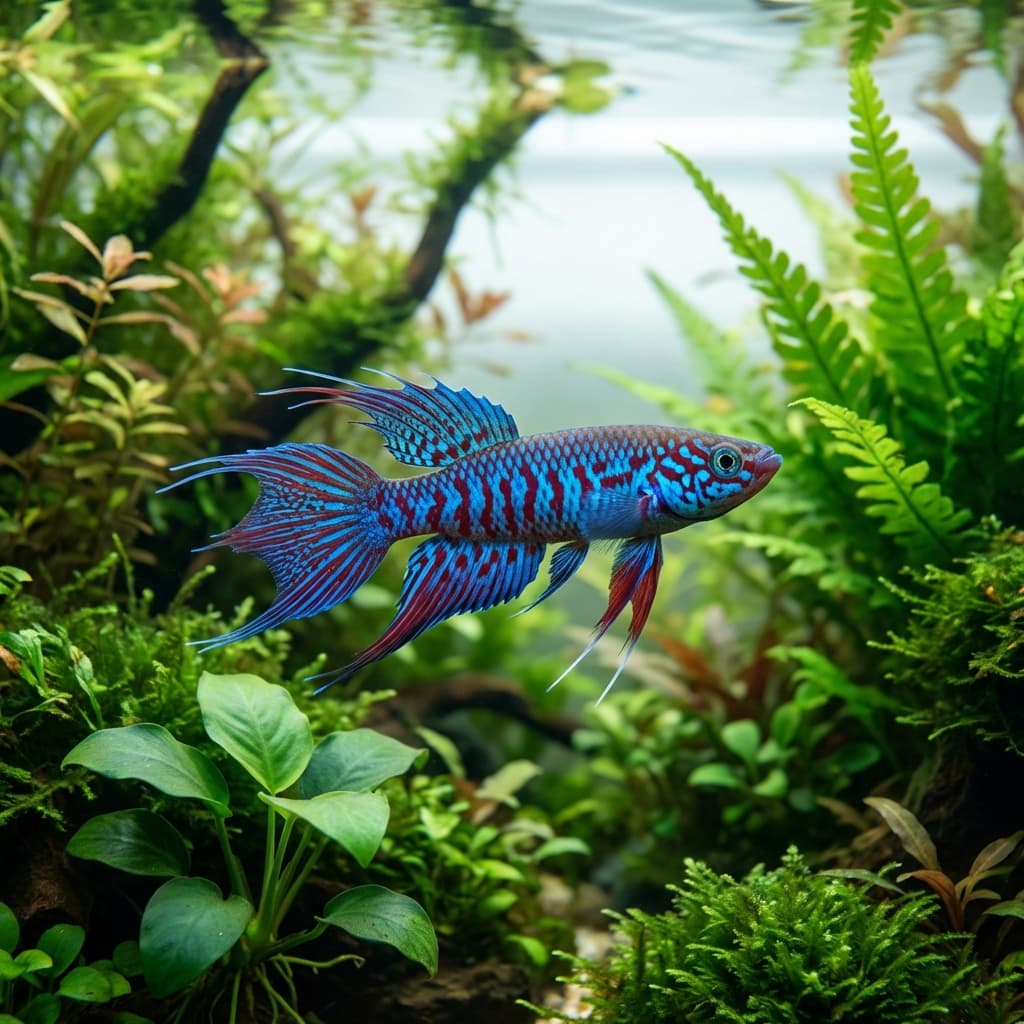
Males are extraordinary: a deep blue-green to turquoise body adorned with red and orange spots and bands, blue facial markings, and a large, lyre-shaped caudal fin with dramatically extended upper and lower lobes in brilliant colours. No two males look identical — the pattern variation is remarkable. Females are considerably more modest in colouration.
The Blue Gularis grows to 12–13 cm, making it large for a killifish and requiring a correspondingly larger aquarium than most killifish species. Despite its magnificent appearance, it is a predatory species — small fish and invertebrates will be consumed. Tank mates must be chosen carefully.
As an annual killifish, breeding involves spawning in the substrate, from which the eggs are collected and stored in moist peat for 3–6 months at reduced temperature before hatching in fresh water — replicating the annual dry/wet season cycle of their natural habitat. This makes it a fascinating but more demanding species to breed.
Care Guide
Tank Setup: A 60-litre minimum for a single pair. Use fine, deep sand substrate or peat for spawning. Dense planting with floating plants for cover and to diffuse lighting. Gentle filtration — killifish prefer calm, slow-moving water. A lid is absolutely essential — killifish are exceptional jumpers.
Water Parameters: Temperature 22–26°C; pH 6.0–7.0; GH 2–10 °dH; KH 1–5 °dH. Soft, slightly acidic water is preferred. Avoid hard, alkaline conditions.
Feeding: Carnivore. Feed live and frozen foods: bloodworm, Daphnia, brine shrimp, earthworms, Tubifex. Larger specimens accept commercially prepared carnivore pellets once acclimatised. Feed once to twice daily. Do not overfeed — rich live food diets can shorten lifespan.
Tank Mates: Only with fish too large to be eaten — the Blue Gularis will consume any small fish or shrimp. Best kept as a species tank or with large, robust fish. Avoid keeping two males together in small tanks — serious combat.
Behaviour: Males are territorial toward each other. A pair can be kept together, or one male with multiple females in a larger tank. Males display magnificent colours when competing for females. Predatory at night — ensure no small fish are present.
Health: Hardy when parameters are stable. Relatively short lifespan (2–3 years) as an annual species. Avoid sudden parameter changes. Provide excellent water quality with regular partial changes.
Buy Blue Gularis Killifish (Fundulopanchax sjoestedti) from FinsHQ shops
Shops currently listing this species with stock available
Sell Blue Gularis Killifish (Fundulopanchax sjoestedti) in your shop?
Join aquarium shops already using FinsHQ. Get a beautiful webshop, mobile app, and inventory management — built for aquatic retailers.
Start your free store