
Clown Killifish (Epiplatys annulatus)
Epiplatys annulatus
Also known as: Clown Killifish, Banded Panchax, Rocket Killifish
Origin: West Africa (Guinea, Liberia, Sierra Leone — still and slow-moving waters)
Water Parameters
Quick Stats
- Max Size
- 4 cm
- Min Tank
- 20 L
- Lifespan
- 4
- Swimming Level
- top
- Schooling
- No
- Diet
- carnivore
- Temperament
- peaceful
About
Epiplatys annulatus, the Clown Killifish or Banded Panchax, is a small, surface-dwelling killifish native to Guinea, Liberia, and Sierra Leone in West Africa, where it inhabits slow-moving to still, heavily vegetated shallow waters, swamps, and forest pools. Despite its diminutive size — adults reach only 3–4 cm — it is one of the most visually striking small fish in the hobby.
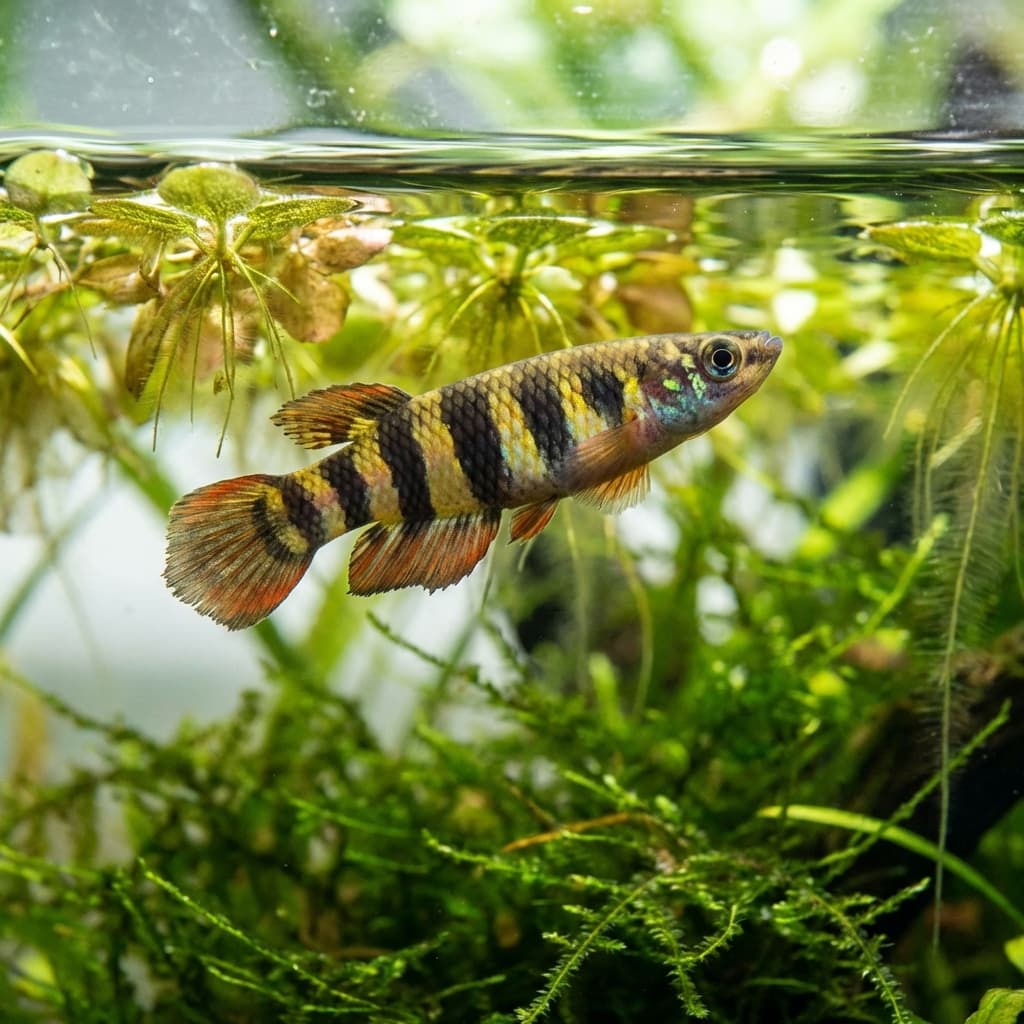
The body displays a series of bold black and cream vertical bands, creating a striking clown-like pattern. The caudal fin is the centrepiece: shaped into a distinctive lyre or flag form with vivid red, blue, and orange coloration in mature males, creating an extraordinary contrast with the banded body. Females are less dramatically coloured with a more rounded, transparent tail.
Unlike many killifish species, Epiplatys annulatus is non-annual — it lives in permanent or semi-permanent water bodies and does not require egg diapause. This makes it considerably more straightforward to breed than annual killifish, as eggs hatch directly in the aquarium among fine-leaved plants or spawning mops after approximately 12–14 days.
The Clown Killifish is a surface fish — it spends most of its time at or near the water surface, hunting small insects and invertebrates. A tightly-fitting lid is absolutely essential as it will jump through even very small gaps.
Care Guide
Tank Setup: A 20–30 litre nano tank with dense surface floating plants (Water Lettuce, Salvinia, Frogbit) and fine-leaved plants below the surface. Very gentle sponge filtration — this is a still-water species intolerant of strong flow. A sealed lid is critical — exceptional jumpers. Dark substrate.
Water Parameters: Temperature 22–26°C; pH 6.0–7.5; GH 2–12 °dH; KH 1–6 °dH. Moderately soft, slightly acidic water. More adaptable than many killifish but avoids hard, alkaline conditions.
Feeding: Carnivore. Primary diet of small live and frozen foods: baby brine shrimp, Daphnia, micro worms, small bloodworm. Mouths are small — all food must be appropriately sized. Feed at the surface once to twice daily. Some individuals accept crushed micro pellets.
Tank Mates: Only with extremely peaceful, small nano species: Boraras, small Danio, Pygmy Corydoras. Absolutely no fish large enough to eat them. Can coexist with adult dwarf shrimp but may eat shrimplets.
Behaviour: Surface-dwelling. Groups of 4–6 with more females than males show natural behaviour. Males display to each other at the surface — harmless but frequent. Spawns among floating plants — eggs hatch in 12–14 days in the aquarium.
Health: Hardy for a killifish. Main vulnerability is jumping — ensure a sealed lid. Sensitive to poor water quality. Weekly 15–20% water changes with matched water chemistry.
Buy Clown Killifish (Epiplatys annulatus) from FinsHQ shops
Shops currently listing this species with stock available
Sell Clown Killifish (Epiplatys annulatus) in your shop?
Join aquarium shops already using FinsHQ. Get a beautiful webshop, mobile app, and inventory management — built for aquatic retailers.
Start your free store