
Congo Tetra (Phenacogrammus interruptus)
Phenacogrammus interruptus
Also known as: Congo Tetra
Origin: Central Africa (Democratic Republic of Congo — Congo River basin)
Water Parameters
Quick Stats
- Max Size
- 9 cm
- Min Tank
- 150 L
- Lifespan
- 5
- Swimming Level
- middle
- Schooling
- Yes (8–20+)
- Diet
- omnivore
- Temperament
- peaceful
About
Phenacogrammus interruptus, the Congo Tetra, is the most spectacular and widely kept African tetra species, native to the Congo River basin in the Democratic Republic of Congo. While most tetra species hail from South America, the Congo Tetra represents the Alestidae family — the African 'characins' — and brings a distinctly different, grand aesthetic to the planted aquarium.
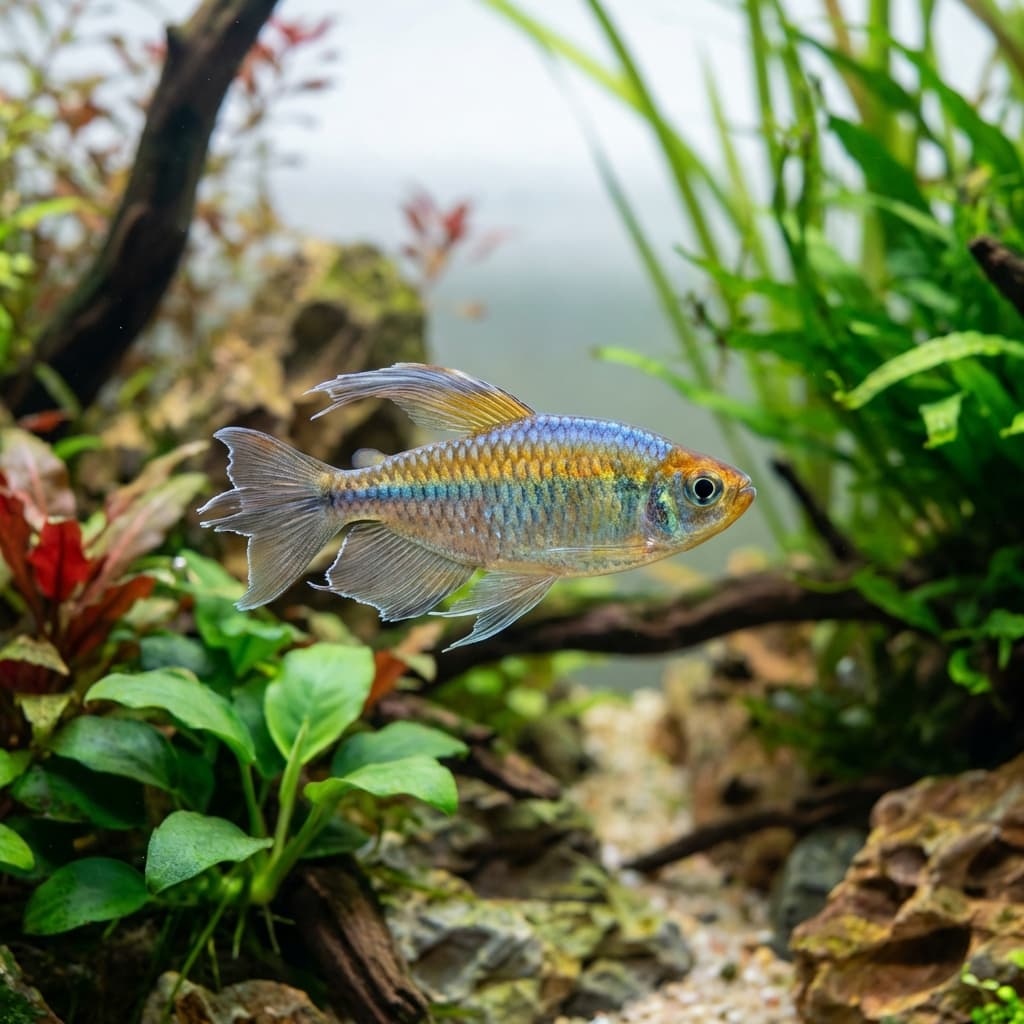
The adult Congo Tetra is a large and imposing tetra by the standards of the group, reaching 8–9 cm in males. The colouration is extraordinary under proper lighting: the body shimmers with a shifting, iridescent spectrum of blue, green, gold, and violet, with a dark lateral band that changes apparent colour with the angle of observation. Males develop dramatically elongated unpaired fins with flowing extensions and a unique frayed, tuft-like extension of the central caudal fin rays — a feature unique to this species.
Females are smaller and less dramatically finned but share the beautiful iridescent body colouration. The sexual dimorphism makes a mixed-sex school of Congo Tetras an excellent display, with males competing through display and females providing contrast with their more compact bodies.
In the wild, Congo Tetras inhabit slow-moving forest streams and pools with soft, slightly acidic, tannin-stained water and dense surface vegetation. In the aquarium, groups of ten or more in a 200+ litre planted tank with appropriate lighting create one of the most spectacular freshwater fish displays available.
Care Guide
Tank Setup: A minimum 150-litre aquarium for a school of eight — 200+ litres for ten or more (strongly preferred). Open mid-water swimming space with planted edges and background, gentle water flow, and dim to moderate lighting. A tight-fitting lid is essential — Congo Tetras jump. Dark substrate enhances the iridescent colouration.
Water Parameters: Temperature 23–27°C; pH 6.0–7.5; GH 3–12 °dH; KH 2–6 °dH. Prefers soft to moderately soft, slightly acidic to neutral water. Avoid very hard, alkaline conditions.
Feeding: Omnivore. Feed quality flake, medium-sized pellets, frozen bloodworm, brine shrimp, and Daphnia. Feed two to three times daily. Larger mouths than most tetras — standard community food works well.
Tank Mates: Compatible with most medium to large peaceful community species: other large tetras, large barbs, rainbowfish, Synodontis catfish, and peaceful cichlids. Avoid fin-nippers that may damage the males' flowing fins. Avoid very small fish.
Behaviour: Peaceful schooling fish. Males display vivid iridescent colours in competition for females. Groups of 10+ produce the most spectacular schooling display. The iridescent colour shifts constantly as the school moves — the visual effect is remarkable.
Health: Hardy once established. Susceptible to ich under stress. Nitrates above 20 ppm cause long-term health decline — regular 25–30% water changes essential. Sensitive to sudden parameter changes.
Buy Congo Tetra (Phenacogrammus interruptus) from FinsHQ shops
Shops currently listing this species with stock available
Sell Congo Tetra (Phenacogrammus interruptus) in your shop?
Join aquarium shops already using FinsHQ. Get a beautiful webshop, mobile app, and inventory management — built for aquatic retailers.
Start your free store