
Dwarf Chain Loach (Ambastaia sidthimunki)
Ambastaia sidthimunki
Also known as: Dwarf Chain Loach, Chain Botia, Sid the Loach
Origin: Southeast Asia (Thailand, Laos, Myanmar — Chao Phraya and Mekong basins)
Water Parameters
Quick Stats
- Max Size
- 6 cm
- Min Tank
- 80 L
- Lifespan
- 8
- Swimming Level
- bottom
- Schooling
- Yes (6–15+)
- Diet
- omnivore
- Temperament
- peaceful
About
Ambastaia sidthimunki, the Dwarf Chain Loach, is one of the most popular and endearing small loaches in the aquarium hobby. Native to the Chao Phraya and Mekong River basins of Thailand, Laos, and Myanmar, it is listed as Endangered due to damming and habitat destruction, though aquarium specimens are captive-bred.
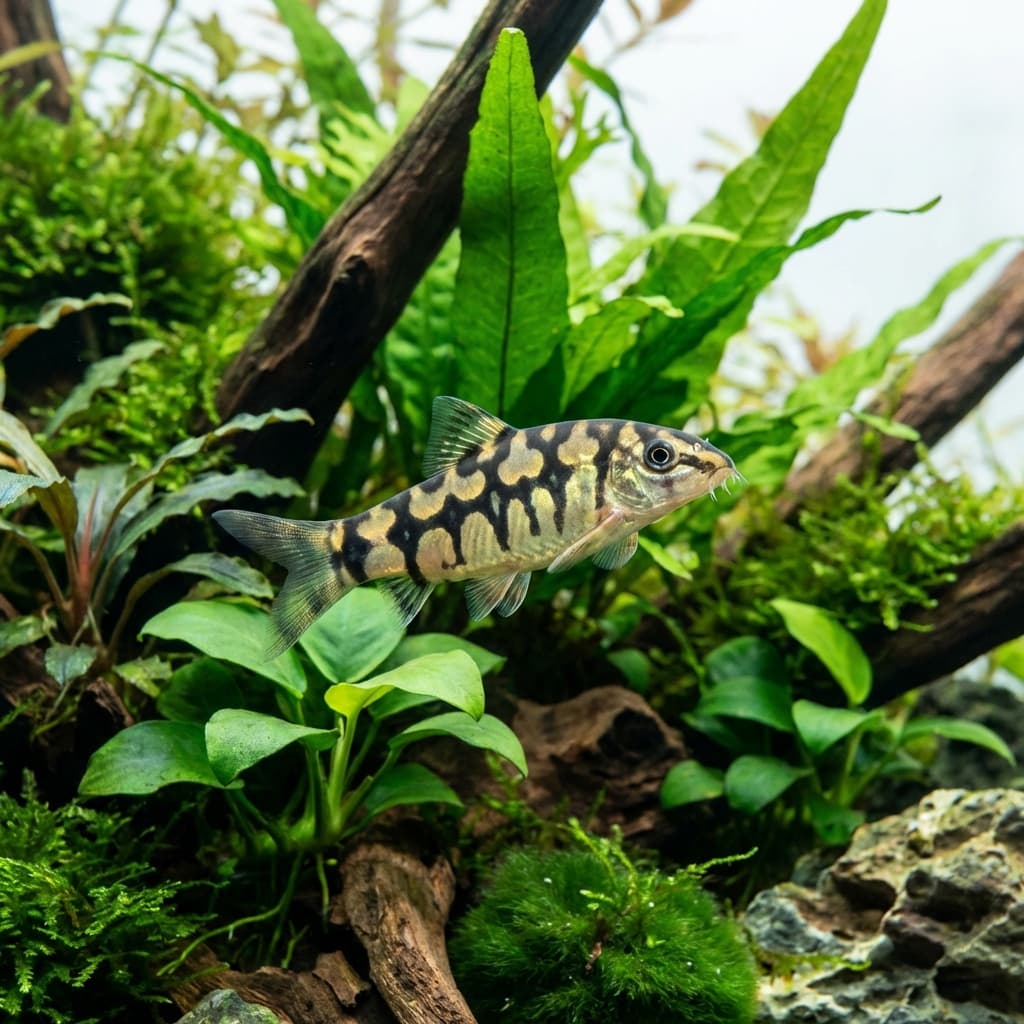
The common name describes the distinctive reticulated body pattern perfectly: dark brown to black diamonds or chain-links on a pale golden to cream body, running the full length of the fish. The pattern creates a beautiful textured appearance unique among loaches commonly available in the hobby.
At approximately 5–6 cm adult size, the Dwarf Chain Loach is among the smallest botiid loaches and one of the most practical for community aquariums where larger species like the Clown Loach (30+ cm) would be impractical. Unlike many loaches that are primarily nocturnal, the Dwarf Chain Loach is often active during the day — particularly when kept in a sufficiently large social group.
Like all botiid loaches, the Dwarf Chain Loach is highly social and develops clear social hierarchies within the group. Solitary individuals or very small groups are stressed and hide constantly. Groups of six or more engage in chasing, play swimming, and the characteristic 'dancing' behaviour — rapidly spinning or twisting in the water column — that is a sign of a happy, socially satisfied group.
Care Guide
Tank Setup: A minimum 80-litre aquarium for a group of six. Fine sand substrate (sensitive to rough substrate), smooth rocks, driftwood, caves (PVC tubes, ceramic caves), and planted edges. Good filtration. Active and boisterous — a tight lid is recommended.
Water Parameters: Temperature 24–30°C; pH 6.5–7.5; GH 5–15 °dH; KH 3–8 °dH. Prefers warm, slightly soft to moderately hard water. Adaptable within these ranges.
Feeding: Omnivore. Sinking pellets, wafers, frozen bloodworm, brine shrimp, Daphnia, and Tubifex. Highly effective natural snail controller — will consume pest snails (Ramshorn, Bladder). Feed in the evening when most active. Ensure food reaches the substrate.
Tank Mates: Peaceful with virtually all medium and large community species. Compatible with tetras, barbs, danios, rasboras, gouramis, corydoras, rainbowfish. Avoid very small nano fish and long-finned fish vulnerable to playful nipping.
Behaviour: Playful and social. Large groups display chasing, somersaulting, and synchronised swimming. 'Playing dead' — lying on their sides — is normal resting behaviour, not illness. Day-active when in a large social group. Effective snail predators.
Health: Hardy once established. Susceptible to ich — treat with caution as loaches can be sensitive to some medications. High temperature (28–30°C) speeds ich treatment. Weekly 25% water changes prevent most issues.
Buy Dwarf Chain Loach (Ambastaia sidthimunki) from FinsHQ shops
Shops currently listing this species with stock available
Sell Dwarf Chain Loach (Ambastaia sidthimunki) in your shop?
Join aquarium shops already using FinsHQ. Get a beautiful webshop, mobile app, and inventory management — built for aquatic retailers.
Start your free store