
German Blue Ram (Mikrogeophagus ramirezi)
Mikrogeophagus ramirezi
Also known as: German Blue Ram, Blue Ram, Butterfly Cichlid, Ram Cichlid
Origin: Orinoco River drainage, Venezuela and Colombia
Water Parameters
Quick Stats
- Max Size
- 7 cm
- Min Tank
- 80 L
- Lifespan
- 3-5
- Swimming Level
- MIDDLE
- Schooling
- No
- Diet
- Omnivore — micro-cichlid pellets, flake, bloodworms, daphnia, brine shrimp, cyclops
- Temperament
- Peaceful; assertive in defense of breeding territory; incompatible with nippy or aggressive species
About
The German Blue Ram (Mikrogeophagus ramirezi) is native to the Orinoco River drainage in Venezuela and Colombia, where it inhabits warm, slow-moving savanna streams and pools with soft, highly acidic water, dense aquatic vegetation, and sandy substrates. The 'German Blue' strain represents a selectively bred form with enhanced blue iridescence on the flanks and fins compared to wild-type specimens.
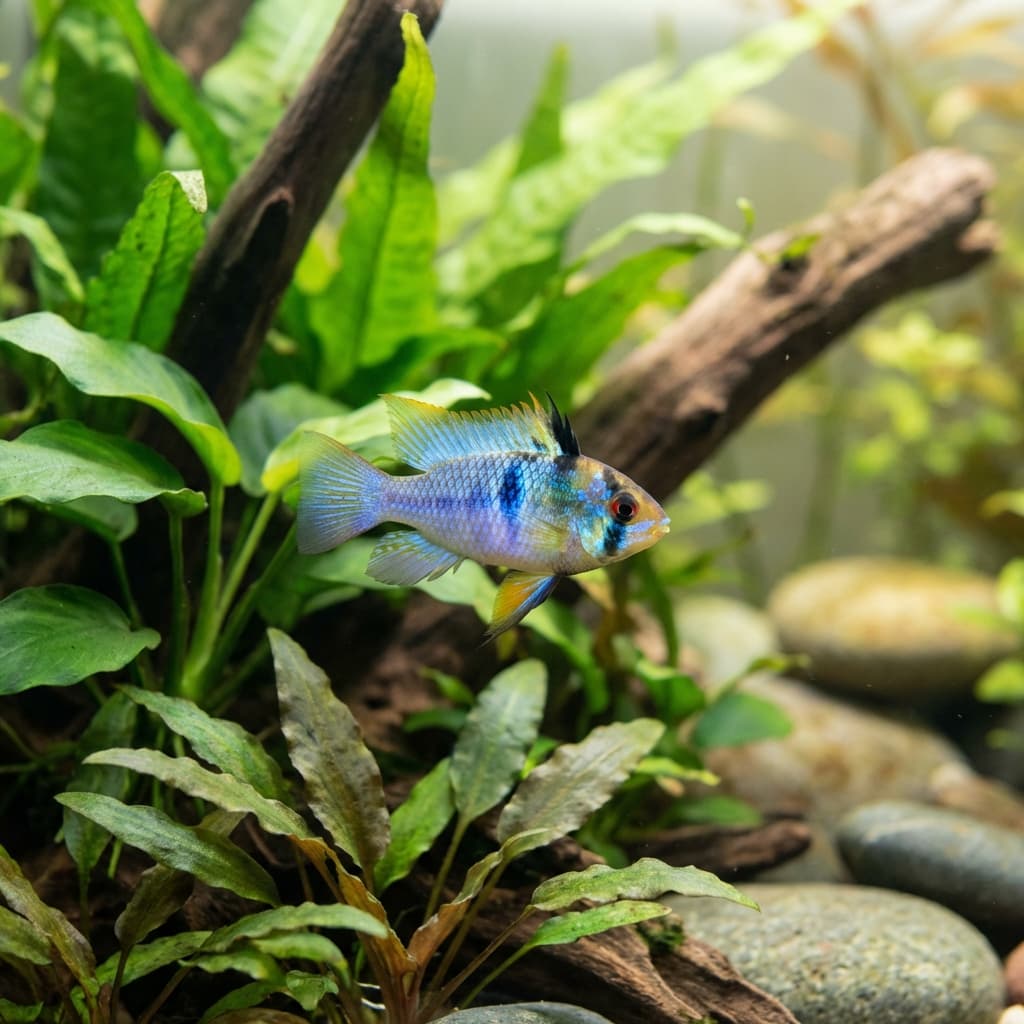
Both male and female German Blue Rams are extraordinarily colored: the body combines vivid yellow-gold on the face and anterior body with brilliant blue iridescent scales across the flanks, black fin edging on the dorsal fin, and a striking red to pink iris that flashes under light. Males develop elongated anterior dorsal fin rays and generally show more intense coloration; females often develop a pink-violet wash on the belly, particularly when breeding.
German Blue Rams are devoted substrate spawners that form monogamous pair bonds. The breeding pair cleans a spawning site (flat stone or sandy depression), deposits a clutch of pale pink eggs, and both parents guard and fan the eggs and larvae with impressive dedication. They are fascinating fish to breed and observe through parental care.
Despite their relatively small size (5–7 cm), German Blue Rams have large personalities and interact readily with their keepers. They are generally peaceful toward other species but become assertive in defense of their breeding territory.
Care Guide
German Blue Rams are one of the more demanding freshwater fish in terms of water quality. They require soft, warm, slightly acidic water: pH 5.5–7.0, hardness 1–10 dGH, and temperatures 26–30°C. Temperatures below 25°C significantly stress this species and increase susceptibility to disease, particularly hole-in-the-head disease (hexamitiasis) and bacterial infections.
A minimum 80-liter planted aquarium suits a pair well. Provide a fine sand substrate, dense plantings of Amazon swords, Vallisneria, Anubias, and mosses, flat stones for spawning, and driftwood for cover. Soft, slightly acidic water is best achieved through RO water blending, peat filtration, or active substrate.
Feed a varied diet of high-quality micro-cichlid pellets, flake food, and regular live or frozen supplements: small bloodworms, daphnia, baby brine shrimp, cyclops, and small earthworms. Feeding varied, protein-rich foods maintains condition and color intensity.
German Blue Rams are compatible with most peaceful community species of appropriate size: small to medium tetras, rasboras, corydoras, small catfish, and peaceful loaches. Avoid nippy species (tiger barbs, serpae tetras) that may target their fins, and avoid large or aggressive cichlids that will bully them.
Water quality must be impeccable — weekly water changes of 30% with temperature-matched soft water maintain the stable conditions this sensitive species requires. They are not forgiving of ammonia spikes, high nitrates, or temperature fluctuations.
Buy German Blue Ram (Mikrogeophagus ramirezi) from FinsHQ shops
Shops currently listing this species with stock available
Sell German Blue Ram (Mikrogeophagus ramirezi) in your shop?
Join aquarium shops already using FinsHQ. Get a beautiful webshop, mobile app, and inventory management — built for aquatic retailers.
Start your free store