
Glass Catfish (Kryptopterus vitreolus)
Kryptopterus vitreolus
Also known as: Glass Catfish, Ghost Catfish, Ghost Glass Catfish
Origin: Thailand and Cambodia — slow-flowing rivers and streams
Water Parameters
Quick Stats
- Max Size
- 8 cm
- Min Tank
- 80 L
- Lifespan
- 5-8
- Swimming Level
- MIDDLE
- Schooling
- Yes (6–12+)
- Diet
- Carnivore — daphnia, baby brine shrimp, cyclops, small bloodworms, micro pellets
- Temperament
- Peaceful; highly social — must be kept in groups of 6+; stressed when isolated
About
The Glass Catfish (Kryptopterus vitreolus) is native to slow-flowing rivers and streams in Thailand and Cambodia, where it forms schools in vegetated, slightly flowing waters. For many years confused with Kryptopterus bicirrhis, the commonly traded aquarium 'glass catfish' was reclassified as K. vitreolus in 2013, with K. bicirrhis being the larger, rarer species.
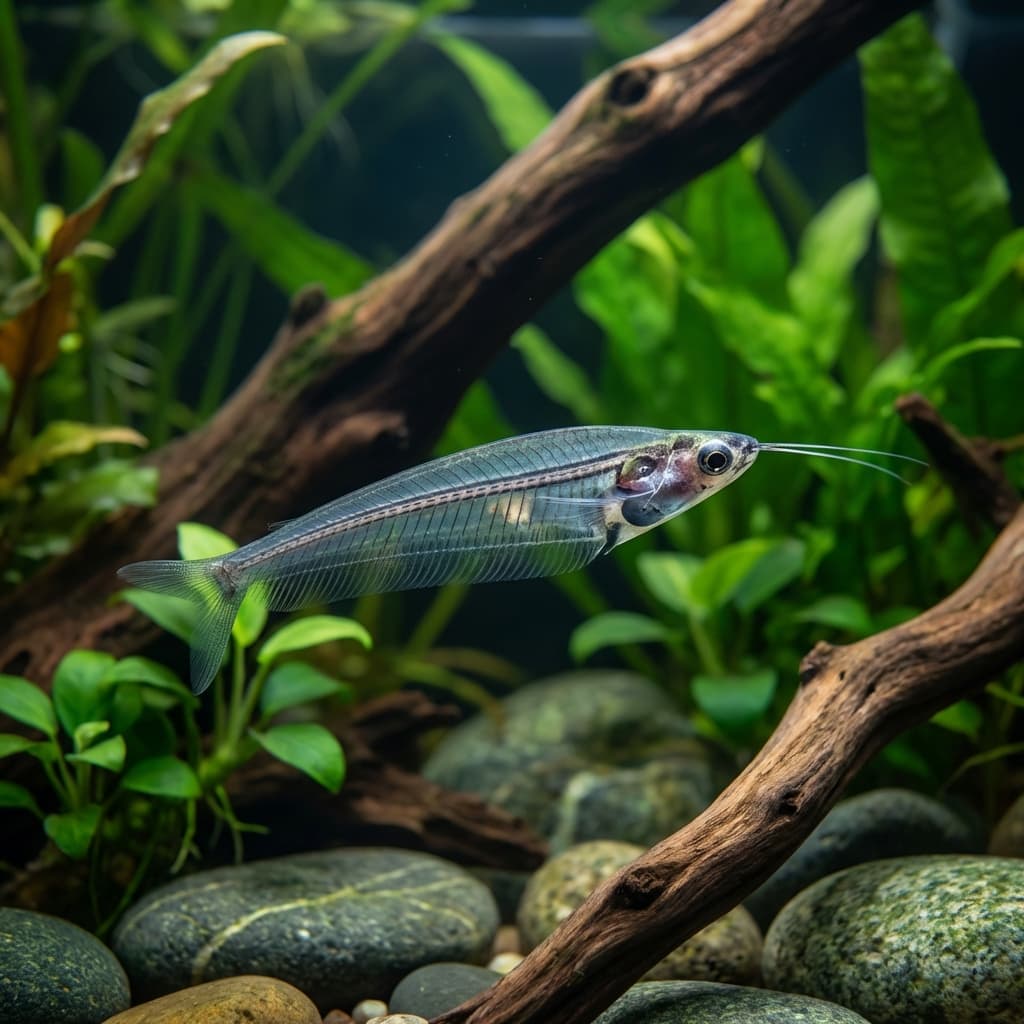
The most striking feature of Kryptopterus vitreolus is its extraordinary transparency — the muscles and skin are so clear that the internal skeleton (vertebrae, ribs) and iridescent swim bladder are directly visible through the body wall. Under certain lighting conditions, the body displays a subtle iridescent sheen of blue, green, and gold that ripples through the transparent tissues.
Unlike most catfish, which are bottom-dwelling and often nocturnal, Glass Catfish are active mid-water swimmers that school together and orient themselves at a characteristic slightly head-down angle in the water column. They are highly social and become stressed when kept in small numbers — solitary individuals cease feeding and deteriorate rapidly.
In the wild, they position themselves in gentle to moderate current facing upstream, using their long barbels (sensory whiskers) to detect food particles drifting past. This behavior is often observed in well-maintained aquariums with gentle current.
Care Guide
Glass Catfish are more sensitive than their undemanding appearance suggests. They require soft to moderately hard, slightly acidic to neutral water: pH 6.5–7.5, hardness 3–10 dGH, and temperatures 20–26°C. They are sensitive to temperature extremes, poor water quality, and sudden parameter changes.
A minimum 80-liter aquarium is recommended for a school of 6+. Provide moderate gentle current (spray bar or powerhead), dense plantings for cover, and open mid-water swimming space. Dim lighting suits them; bright light causes stress and hiding behavior. Driftwood and dense vegetation create a natural feel.
Feed small, meaty foods that can be delivered to mid-water: daphnia, baby brine shrimp, cyclops, small bloodworms, and micro pellets. They primarily catch food mid-water and may struggle with sinking foods. Feed 2–3 times daily in small amounts.
Glass Catfish are entirely peaceful and suitable with other small to medium peaceful species: tetras, rasboras, corydoras, small loaches, and dwarf cichlids. Avoid boisterous or aggressive fish that stress them. Never house alone — keep in groups of at least 6, with 8–10 strongly preferred.
Regular water changes of 25–30% weekly maintain the water quality this sensitive species needs. Avoid sudden temperature drops or large water changes that shock the fish. They are vulnerable to ich (white spot disease) under stress — maintain stable, good conditions as prevention.
Buy Glass Catfish (Kryptopterus vitreolus) from FinsHQ shops
Shops currently listing this species with stock available
Sell Glass Catfish (Kryptopterus vitreolus) in your shop?
Join aquarium shops already using FinsHQ. Get a beautiful webshop, mobile app, and inventory management — built for aquatic retailers.
Start your free store