
Gold Dust Molly (Poecilia sphenops var.)
Poecilia sphenops var.
Also known as: Gold Dust Molly, Dalmatian Gold Dust Molly
Origin: Ornamental variety derived from Poecilia sphenops — native range Mexico through Central America to northern South America
Water Parameters
Quick Stats
- Max Size
- 10 cm
- Min Tank
- 80 L
- Lifespan
- 3-5
- Swimming Level
- MIDDLE
- Schooling
- No
- Diet
- Omnivore — spirulina flakes, algae wafers, blanched vegetables, flake, daphnia, brine shrimp
- Temperament
- Peaceful; males may harass females — maintain 2:1 female ratio
About
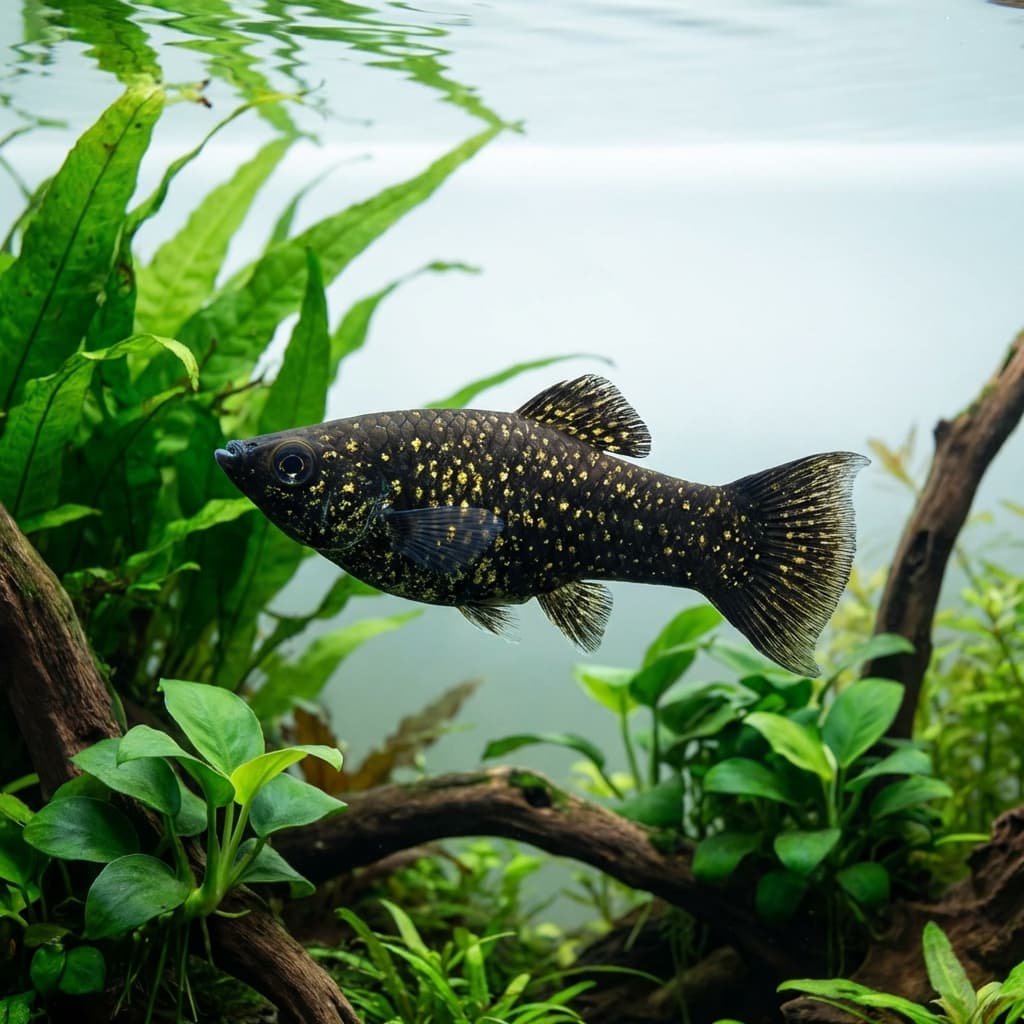
The Gold Dust Molly is a cultivated variety of Poecilia sphenops — the Short-finned or Common Molly — selectively bred for distinctive golden-yellow speckling or 'dust' distributed across the body, contrasting with a darker or lighter base coloration depending on the specific strain. Poecilia sphenops is native to freshwater and brackish environments from Mexico through Central America and into northern South America.
Mollies are livebearers, with females giving birth to relatively large, fully-formed fry after a gestation period of 4–6 weeks. Females have a characteristic dark gravid spot near the anal fin that darkens as birth approaches. Males are distinguished by a modified anal fin (gonopodium) used for internal fertilization.
The Gold Dust Molly typically reaches 6–10 cm for females and 5–8 cm for males. Males may develop impressive dorsal fin extensions in some strains. The species exhibits significant variation in body form, coloration, and fin shape depending on breeding strain.
Mollies are among the few freshwater fish that perform extremely well with the addition of a small amount of aquarium salt to their tank, and some hobbyists maintain them in fully brackish conditions (specific gravity 1.002–1.005) where they remain exceptionally healthy. In straight freshwater, they still thrive provided water is hard and alkaline.
Care Guide
Gold Dust Mollies prefer hard, alkaline water: pH 7.5–8.5, hardness 15–30 dGH, and temperatures 24–28°C. Adding 1–3 teaspoons of aquarium salt per 10 liters significantly benefits their health and reduces susceptibility to disease, though they adapt to freshwater without salt when conditions are otherwise good.
A minimum 80-liter aquarium suits a small group. Dense plantings, including floating plants, provide cover for fry and diffuse surface light. Good filtration maintains the water quality mollies require. They are susceptible to 'shimmying' (a neurological wobbling behavior) when water quality deteriorates or parameters are wrong.
Feed a varied diet with significant plant-based components: spirulina flakes, algae wafers, blanched vegetables (zucchini, spinach), supplemented with quality flake food, daphnia, and brine shrimp. Mollies graze on algae and need vegetable matter for optimal health.
Gold Dust Mollies are peaceful community fish compatible with other mollies, guppies, platies, swordtails, and other hard-water fish. Avoid housing with soft-water species whose water requirements conflict with mollies' hard, alkaline preferences. Males may occasionally harass females — maintain a 2:1 female-to-male ratio.
Mollies breed prolifically — expect regular broods of 20–80 fry. Dense plantings or a separate breeding/rearing tank allow fry survival. Population management may be necessary in established tanks.
Buy Gold Dust Molly (Poecilia sphenops var.) from FinsHQ shops
Shops currently listing this species with stock available
Sell Gold Dust Molly (Poecilia sphenops var.) in your shop?
Join aquarium shops already using FinsHQ. Get a beautiful webshop, mobile app, and inventory management — built for aquatic retailers.
Start your free store