
Killifish - Aphyosemion australe (Lyretail)
Aphyosemion australe
Also known as: Lyretail Killifish, Cape Lopez Lyretail, Lyretail Panchax
Origin: Coastal Gabon and adjacent Republic of Congo, West Central Africa
Water Parameters
Quick Stats
- Max Size
- 7 cm
- Min Tank
- 30 L
- Lifespan
- 2-4
- Swimming Level
- MIDDLE
- Schooling
- No
- Diet
- Carnivore — micro pellets, daphnia, baby brine shrimp, bloodworms, micro worms
- Temperament
- Peaceful; males compete with each other — maintain 2 females per male
About
Aphyosemion australe is a non-annual killifish native to coastal Gabon and adjacent Republic of Congo in West Central Africa, first collected near Cape Lopez (now called Cap Lopez) on Gabon's coast — giving rise to one of its common names. Unlike annual killifish species that complete their life cycle within a single wet season, A. australe is a non-annual species that can live 2–4 years under good aquarium conditions.
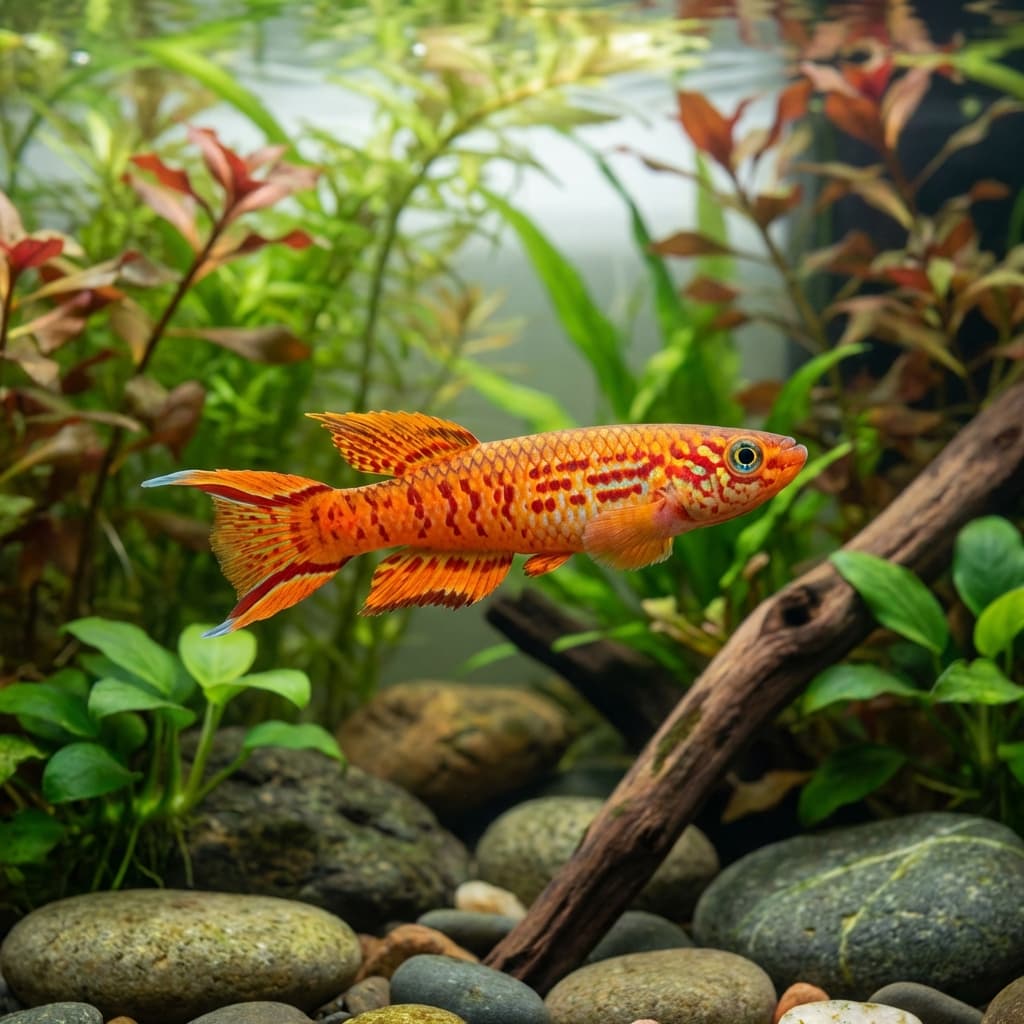
Males are extraordinarily beautiful: the body is covered with a dense pattern of red-orange, crimson, and occasionally blue spots scattered across an orange-brown base, with the spots continuing into the fins. The caudal fin is deeply forked with upper and lower rays extending into long, elegant filaments — the 'lyretail' that gives the species one of its common names. Female coloration is much more subdued, with minimal spotting and rounded fins.
A. australe inhabits forest streams and pools in equatorial West Africa — slow-moving, soft, acidic waters shaded by dense forest canopy. The water is typically dark with tannins, cool, and oxygen-rich from surface area.
In the aquarium, Lyretail Killifish are among the easiest and most rewarding killifish species to keep, offering spectacular male coloration and manageable care requirements. They are egg scatterers that deposit adhesive eggs among fine-leaved plants or peat moss, with eggs typically hatching in 14–21 days.
Care Guide
Lyretail Killifish prefer soft, slightly acidic water: pH 6.0–7.5, hardness 3–10 dGH, and temperatures 20–24°C. They prefer cooler temperatures than most tropical fish — sustained temperatures above 24–25°C stress them and shorten their lifespan. They are sensitive to high nitrate levels.
A small, dedicated aquarium of 30–60 liters with a tight-fitting lid (essential — killifish are expert jumpers) suits a pair or trio well. Dense plantings of fine-leaved plants (Java moss, Ceratopteris, Hornwort) provide spawning sites and cover. Floating plants diffuse light and replicate forest-shaded conditions. Dark substrate, driftwood, and Indian almond leaves enhance the natural environment.
Feed a varied, protein-rich diet: micro pellets, daphnia, baby brine shrimp, bloodworms, and micro worms. Live and frozen foods should form a significant portion of the diet — killifish thrive and breed most readily on varied live and frozen feeding.
Lyretail Killifish can be kept in small, peaceful community setups with gentle species of similar size: small corydoras, small rasboras, and peaceful nano fish. Males may compete with each other — maintain 2 females per male. Avoid aggressive or nippy species.
For breeding, provide Java moss or fine mop spawning material. Collect eggs or transfer plants to a separate hatching container. Fry are tiny — feed infusoria and micro worms initially, graduating to baby brine shrimp as they grow.
Buy Killifish - Aphyosemion australe (Lyretail) from FinsHQ shops
Shops currently listing this species with stock available
Sell Killifish - Aphyosemion australe (Lyretail) in your shop?
Join aquarium shops already using FinsHQ. Get a beautiful webshop, mobile app, and inventory management — built for aquatic retailers.
Start your free store