
Lambchop Rasbora (Trigonostigma espei)
Trigonostigma espei
Also known as: Lambchop Rasbora, Slim Harlequin Rasbora, Espei Rasbora
Origin: Thailand and Cambodia — peat swamp and forest streams
Water Parameters
Quick Stats
- Max Size
- 4.5 cm
- Min Tank
- 60 L
- Lifespan
- 4-6
- Swimming Level
- MIDDLE
- Schooling
- Yes (8–20+)
- Diet
- Omnivore — flake, micro pellets, daphnia, brine shrimp, cyclops, bloodworms
- Temperament
- Peaceful; schooling community fish compatible with virtually all peaceful species
About
The Lambchop Rasbora (Trigonostigma espei) is native to the slow-moving, vegetated streams and rivers of Thailand and Cambodia — particularly peat swamp and forest stream habitats with soft, acidic, tannin-stained water. It is closely related to the Harlequin Rasbora (T. heteromorpha) and the Hengeli Rasbora (T. hengeli), and can be confused with both, particularly T. hengeli.
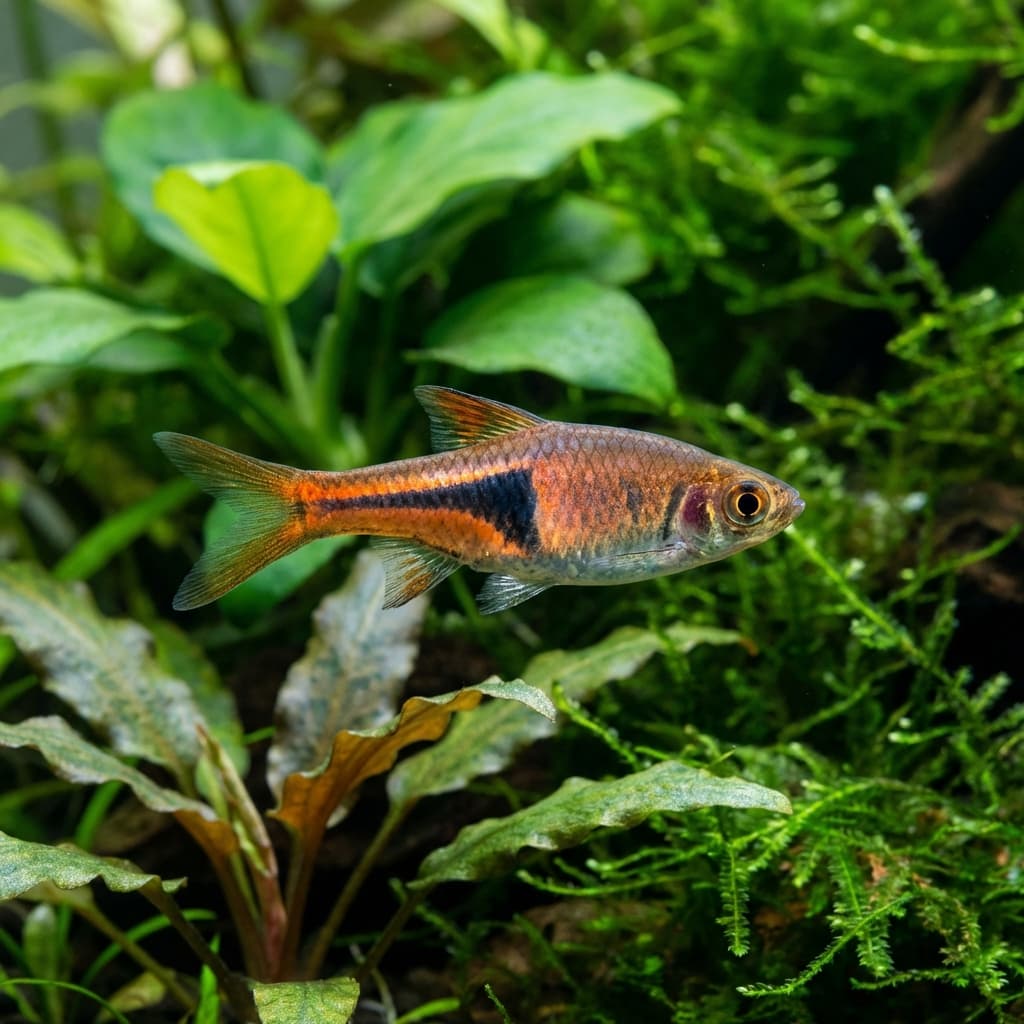
The distinguishing feature of T. espei is the lambda (wedge-shaped) marking on the posterior body: compared to T. heteromorpha, the Lambchop Rasbora has a more elongated body profile and the dark marking is more slender and blade-like — resembling a lambchop outline — rather than the broader, triangular patch of the Harlequin. The body coloration is warm copper-orange to pinkish-tan, slightly paler and more translucent than the classic Harlequin. Males are slimmer; females more rounded.
In the wild, Lambchop Rasboras inhabit blackwater environments with dense vegetation, leaf litter substrates, and soft, acidic, low-mineral water. Like T. heteromorpha, they have adapted over generations of captive breeding to tolerate a wider range of water conditions.
In the aquarium, Lambchop Rasboras display the same peaceful, social schooling behavior as their Harlequin relatives, making them equally well-suited for planted community setups.
Care Guide
Lambchop Rasboras adapt to pH 5.5–7.5, hardness 1–12 dGH, and temperatures 22–28°C. Slightly acidic, soft water replicating their natural blackwater habitat produces the best coloration and most natural behavior.
A minimum 60-liter planted aquarium suits a group of 8–10. Provide dark substrate, driftwood, Indian almond leaves, fine-leaved plants, and gentle current. Dense plantings create the shaded, vegetated conditions they prefer.
Feed quality flake food, micro pellets, and live or frozen supplements: daphnia, baby brine shrimp, cyclops, and small bloodworms. They are adaptable, enthusiastic feeders.
Entire peaceful and compatible with virtually all community species: tetras, corydoras, small catfish, gouramis, livebearers, and peaceful dwarf cichlids. Avoid nippy or aggressive species.
Keep in groups of at least 8 for natural schooling behavior. Weekly water changes of 25–30% maintain water quality.
Buy Lambchop Rasbora (Trigonostigma espei) from FinsHQ shops
Shops currently listing this species with stock available
Sell Lambchop Rasbora (Trigonostigma espei) in your shop?
Join aquarium shops already using FinsHQ. Get a beautiful webshop, mobile app, and inventory management — built for aquatic retailers.
Start your free store