
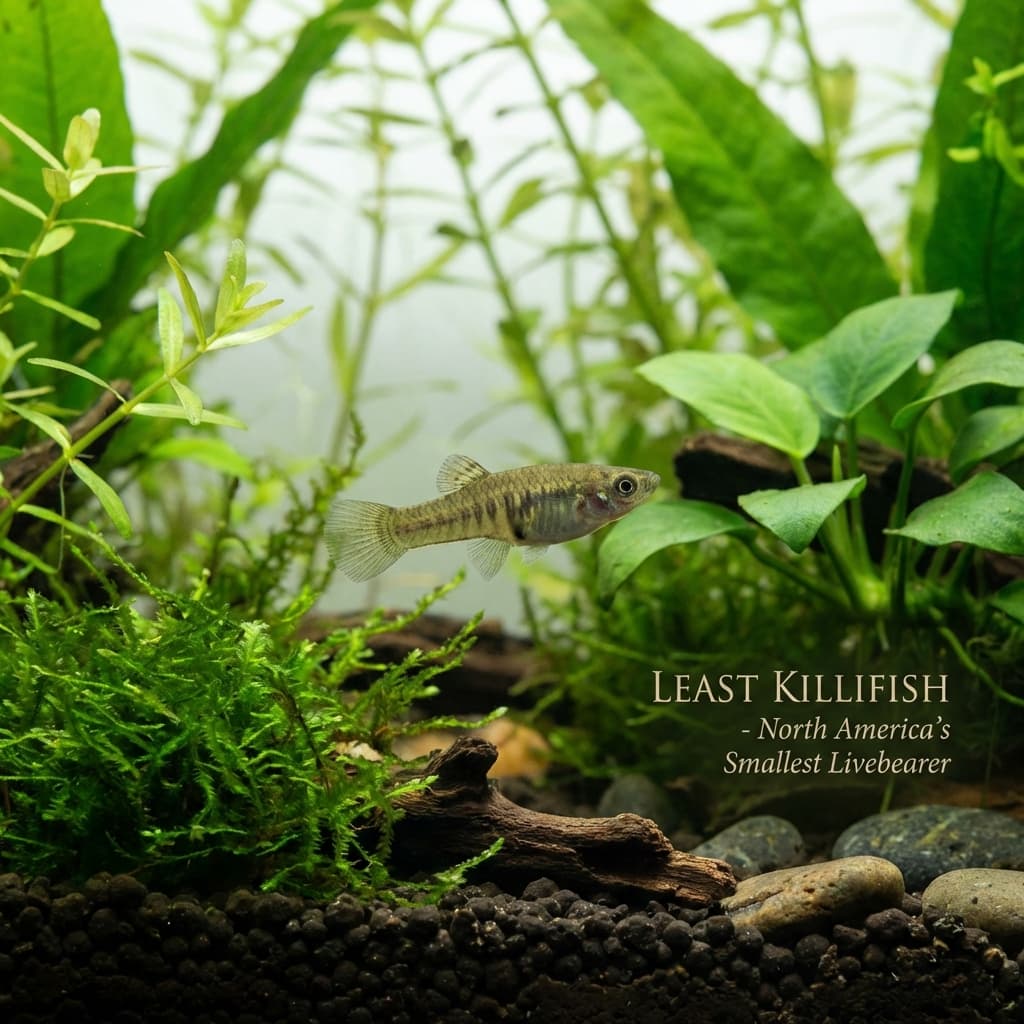
Least Killifish (Heterandria formosa)
Heterandria formosa
Also known as: Least Killifish, Mosquitofish, Dwarf Livebearer
Origin: Atlantic coastal plain of southeastern USA — South Carolina, Florida, Louisiana
Water Parameters
Quick Stats
- Max Size
- 3.5 cm
- Min Tank
- 20 L
- Lifespan
- 2-4
- Swimming Level
- MIDDLE
- Schooling
- No
- Diet
- Omnivore — baby brine shrimp nauplii, micro worms, infusoria, crushed flake; micro-sized foods only
- Temperament
- Peaceful; species-only or shrimp-only tank recommended; all standard community fish are predators
About
Heterandria formosa holds the distinction of being one of the smallest vertebrate animals in the world. Despite its common name 'Least Killifish,' it is not a killifish but rather a livebearer (family Poeciliidae) closely related to guppies and mosquitofish. It is native to the Atlantic coastal plain of the southeastern United States — from South Carolina south through Florida and west to Louisiana — where it inhabits slow-moving, heavily vegetated freshwater habitats including marshes, swamps, ponds, ditches, and sluggish streams.
Females reach a maximum of approximately 3.5 cm; males are tiny at 1.5–2 cm — making this one of the most extreme examples of sexual size dimorphism among vertebrates. Despite their minute size, both sexes are attractively patterned with a dark lateral stripe running from the snout to the tail base, overlaid with subtle spots and a characteristic dark spot at the base of the dorsal fin.
Heterandria formosa exhibits superfetation — the ability to carry simultaneously fertilized broods at multiple stages of development. This means females give birth to just 1–5 fry at a time but do so frequently (every 4–10 days) rather than producing large broods at once. The fry are proportionally large relative to the mother and emerge fully formed and capable of independent feeding.
This tiny North American native is an exceptional species for nano planted setups, species tanks, or ponds in temperate climates.
Care Guide
Least Killifish are North American subtropicals tolerating a wide range of conditions: pH 7.0–8.0, hardness 8–20 dGH, and temperatures 15–28°C. They are remarkably cold-tolerant, surviving temperatures approaching 10°C, and can be kept in outdoor garden ponds in temperate climates seasonally.
A nano aquarium of 20–40 liters is suitable for a group. Provide very dense plantings of fine-leaved plants (Hornwort, Java moss, Guppy Grass, Elodea) — the tiny fry need dense cover to survive alongside adults. Gentle sponge filtration is essential — any filter intake that is not covered with a sponge will suck in fry.
Feed micro-sized foods appropriate for their tiny mouths: baby brine shrimp nauplii, micro worms, infusoria, and finely crushed flake. Standard aquarium foods may be too large. Feed small amounts 2–3 times daily.
Least Killifish should ideally be kept in species-only setups or with similarly tiny, non-predatory species: freshwater shrimp (Neocaridina), small snails, or other micro fish. Any fish large enough to swallow them (which includes most standard community fish) must be avoided — even small tetras may consume adults.
Provide a floating plant layer (Salvinia, Lemna) for surface cover. Their unique superfetation breeding strategy produces a continuous trickle of fry that can sustain a population in a well-planted nano tank.
Buy Least Killifish (Heterandria formosa) from FinsHQ shops
Shops currently listing this species with stock available
Sell Least Killifish (Heterandria formosa) in your shop?
Join aquarium shops already using FinsHQ. Get a beautiful webshop, mobile app, and inventory management — built for aquatic retailers.
Start your free store