
Longfin Blue Eye Rainbowfish (Pseudomugil cyanodorsalis)
Pseudomugil cyanodorsalis
Also known as: Longfin Blue Eye, Blue-backed Blue Eye, Neon Blue Eye
Origin: Northern Australia (Northern Territory, Queensland) and southern New Guinea — coastal mangrove habitats
Water Parameters
Quick Stats
- Max Size
- 5 cm
- Min Tank
- 60 L
- Lifespan
- 3-5
- Swimming Level
- MIDDLE
- Schooling
- Yes (6–12+)
- Diet
- Omnivore — nano pellets, baby brine shrimp, daphnia, micro worms, crushed flake
- Temperament
- Peaceful; males perform constant courtship displays; tolerates slightly brackish conditions
About
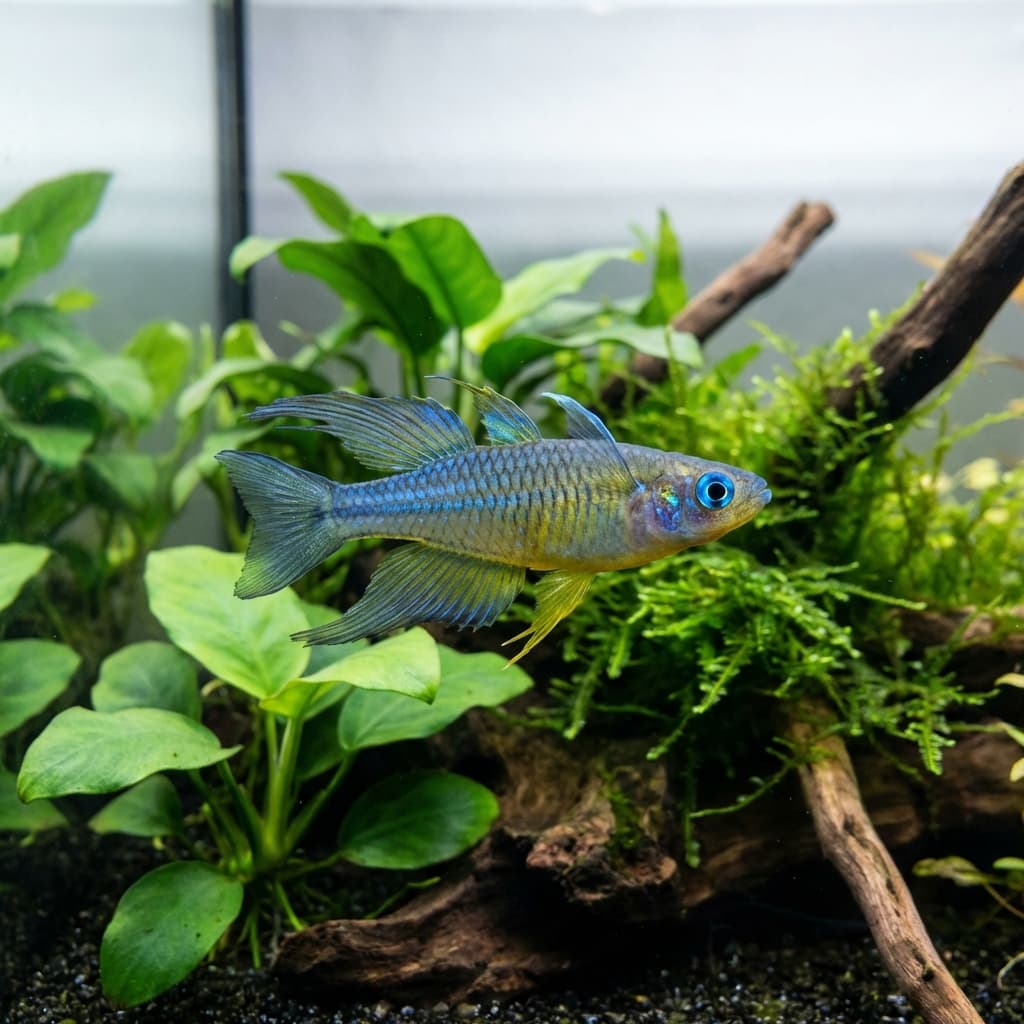
Pseudomugil cyanodorsalis is a small blue-eye rainbowfish native to coastal mangrove habitats and adjacent freshwater systems of northern Australia (Northern Territory and Queensland) and southern New Guinea. The species name 'cyanodorsalis' means 'blue-backed' — referring to the striking iridescent blue-green dorsal coloration visible on the back of both sexes.
Males are spectacular: beyond the blue dorsal surface and brilliant cobalt-blue iris shared by all Pseudomugil species, males develop elongated dorsal and anal fin extensions that increase their visual profile during courtship displays. The overall body is semi-transparent with warm gold highlights on the flanks. Females are smaller and less ornate but share the characteristic blue iris.
Uniquely among common aquarium blue-eyes, P. cyanodorsalis naturally inhabits brackish mangrove habitats and can thrive in slightly saline conditions. In the wild, it is found in shallow, tidal mangrove forests and adjacent freshwater streams where it experiences varying salinity conditions. This makes it more tolerant of hard, mineral-rich water than most Pseudomugil species.
In the aquarium, Longfin Blue Eyes perform constant courtship displays — males spread all fins simultaneously and perform spiral swimming patterns to attract females — behavior that makes groups endlessly engaging to observe.
Care Guide
Longfin Blue Eyes tolerate a wider range of water conditions than most Pseudomugil species: pH 7.0–8.5, hardness 8–20 dGH, and temperatures 22–28°C. They can tolerate and benefit from a small amount of aquarium salt (1–2 tsp per 10L) reflecting their brackish natural habitat, but adapt well to moderately hard freshwater.
A minimum 60-liter planted aquarium suits a group of 6–8. Dense fine-leaved plants provide spawning sites — they scatter adhesive eggs among vegetation. Moderate lighting and gentle current create a comfortable environment. Include floating plants for surface cover.
Feed small, varied foods: nano pellets, baby brine shrimp, daphnia, micro worms, and crushed flake. Their small mouths require appropriately sized food. Feed 2–3 times daily.
Longfin Blue Eyes are peaceful and can be kept with other small, gentle species tolerating similar water conditions: small livebearers, small hard-water tetras, small corydoras, and other Pseudomugil species. Avoid soft-water species with incompatible water requirements.
Maintain groups with more females than males (2:1 ratio). Keep in groups of at least 6 for natural courtship display behavior. Water changes of 20–25% weekly maintain water quality.
Buy Longfin Blue Eye Rainbowfish (Pseudomugil cyanodorsalis) from FinsHQ shops
Shops currently listing this species with stock available
Sell Longfin Blue Eye Rainbowfish (Pseudomugil cyanodorsalis) in your shop?
Join aquarium shops already using FinsHQ. Get a beautiful webshop, mobile app, and inventory management — built for aquatic retailers.
Start your free store