
Marble Hatchetfish (Carnegiella strigata)
Carnegiella strigata
Also known as: Marble Hatchetfish, Marbled Hatchetfish
Origin: Amazon River basin (Peru, Brazil) and Orinoco River system
Water Parameters
Quick Stats
- Max Size
- 4.5 cm
- Min Tank
- 80 L
- Lifespan
- 3-5
- Swimming Level
- TOP
- Schooling
- Yes (8–15+)
- Diet
- Carnivore — floating flake, floating pellets, daphnia, fruit flies, brine shrimp delivered to surface
- Temperament
- Peaceful; surface specialist; secure lid essential — capable jumpers
About
Carnegiella strigata is native to the Amazon River basin — particularly the Peruvian and Brazilian Amazon — and the Orinoco River system, where it inhabits the surface layer of slow-moving, heavily vegetated streams, flooded forests, and river margins. Together with the Common Hatchetfish (Gasteropelecus sternicla) and Silver Hatchetfish, it represents the hatchetfish family (Gasteropelecidae) — named for their distinctive deep, hatchet-shaped body profile.
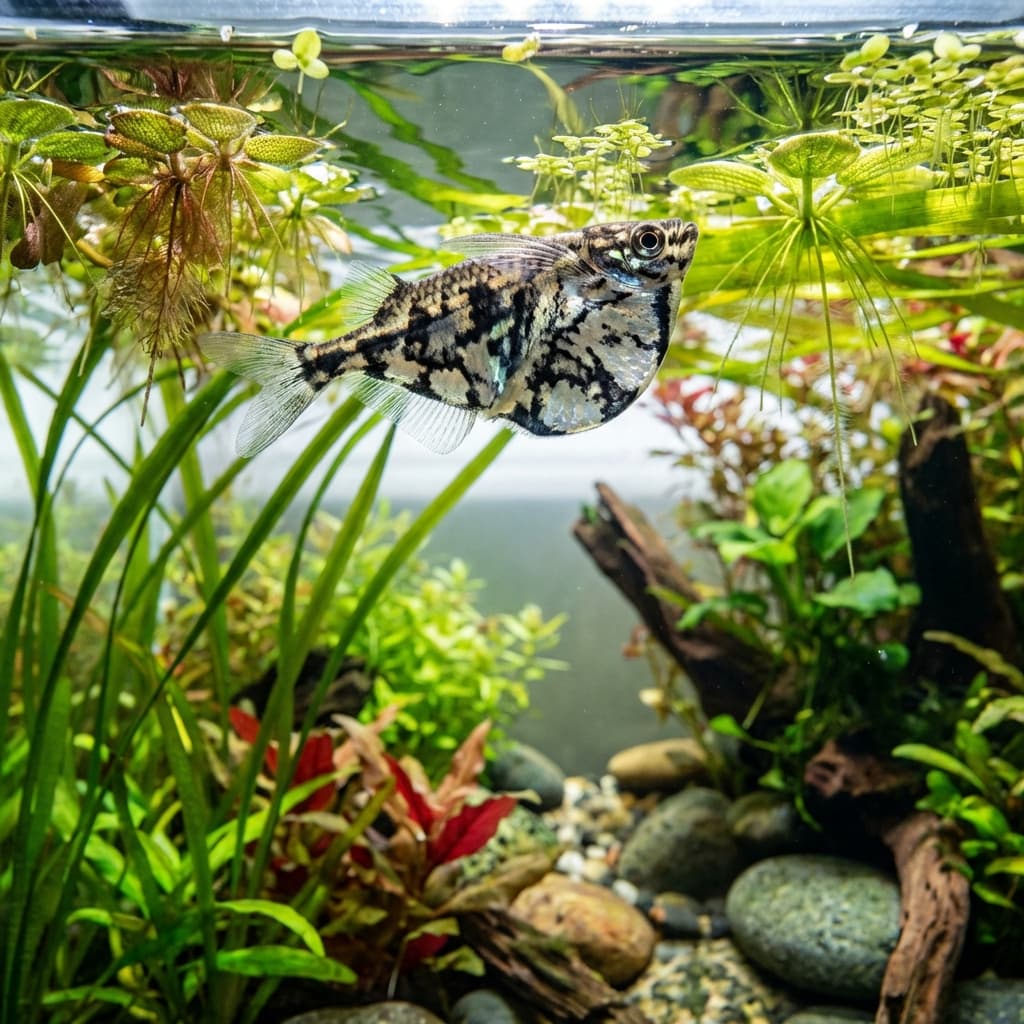
The body is highly laterally compressed with a dramatically deep ventral keel — the 'hatchet' shape — formed by an enormously developed pectoral girdle and musculature. The pectoral fins are large relative to body size and can vibrate rapidly, enabling the fish to skip briefly across the water surface in bursts — a unique 'flying fish' behavior used to escape predators. A secure lid is absolutely essential to prevent escape.
Coloration is a delicate, intricate pattern of dark brown to black horizontal lines and irregular patches on a silver base body, creating a marbled appearance — distinct from the plain silver Gasteropelecus species. The pattern varies between individuals.
Marble Hatchetfish are surface specialists that hover just below the surface film, rarely descending into deeper water. They must be provided with surface-area food and maintained in aquariums with adequate surface area.
Care Guide
Marble Hatchetfish require soft, slightly acidic water: pH 5.5–7.0, hardness 1–8 dGH, and temperatures 24–28°C. They are more sensitive to water quality than their appearance suggests — ammonia and nitrite must be zero, and they are susceptible to ich (white spot) and other diseases under stress.
A minimum 80-liter aquarium with dense surface plantings (floating plants: Salvinia, Frogbit, Water Lettuce) provides essential cover and creates the shaded surface environment they prefer. Open areas of surface water allow their natural surface-hovering behavior. A tight-fitting, weighted lid with no gaps is critical — they can jump 2–3 times their body length.
Feed surface-dwelling foods: floating micro pellets, floating flake, freeze-dried daphnia or bloodworms placed at the surface, and live or frozen daphnia, fruit flies, or baby brine shrimp that drift into the surface film. They will not readily descend to feed on sinking foods.
Marble Hatchetfish are entirely peaceful and suitable with small, gentle, peaceful species that occupy lower water levels: corydoras (bottom), small tetras (mid-water), and small rasboras. Avoid boisterous fish that may disturb the calm surface environment, or large fish that may see them as prey.
Keep in groups of at least 8 for confident schooling behavior. Regular small water changes (20–25% twice weekly) maintain the water quality this sensitive species requires. Drip acclimate carefully when introducing to new tanks.
Buy Marble Hatchetfish (Carnegiella strigata) from FinsHQ shops
Shops currently listing this species with stock available
Sell Marble Hatchetfish (Carnegiella strigata) in your shop?
Join aquarium shops already using FinsHQ. Get a beautiful webshop, mobile app, and inventory management — built for aquatic retailers.
Start your free store