
Neon Tetra (Paracheirodon innesi)
Paracheirodon innesi
Also known as: Neon Tetra
Origin: Blackwater tributaries of the upper Amazon — Peru and western Brazil
Water Parameters
Quick Stats
- Max Size
- 4 cm
- Min Tank
- 60 L
- Lifespan
- 5-10
- Swimming Level
- MIDDLE
- Schooling
- Yes (10–30+)
- Diet
- Omnivore — micro flake, micro pellets, daphnia, brine shrimp, cyclops, micro worms
- Temperament
- Peaceful; world's most popular schooling community fish; compatible with all peaceful species
About
Paracheirodon innesi is native to the blackwater tributaries of the upper Amazon River system in Peru and western Brazil — particularly the Putumayo and Solimões rivers — where it inhabits slow-moving, heavily vegetated forest streams with soft, extremely acidic, dark water. First collected for the aquarium trade in 1934 and named after William T. Innes, the Neon Tetra rapidly became one of the most popular aquarium fish in history — a status it maintains nearly 90 years later.
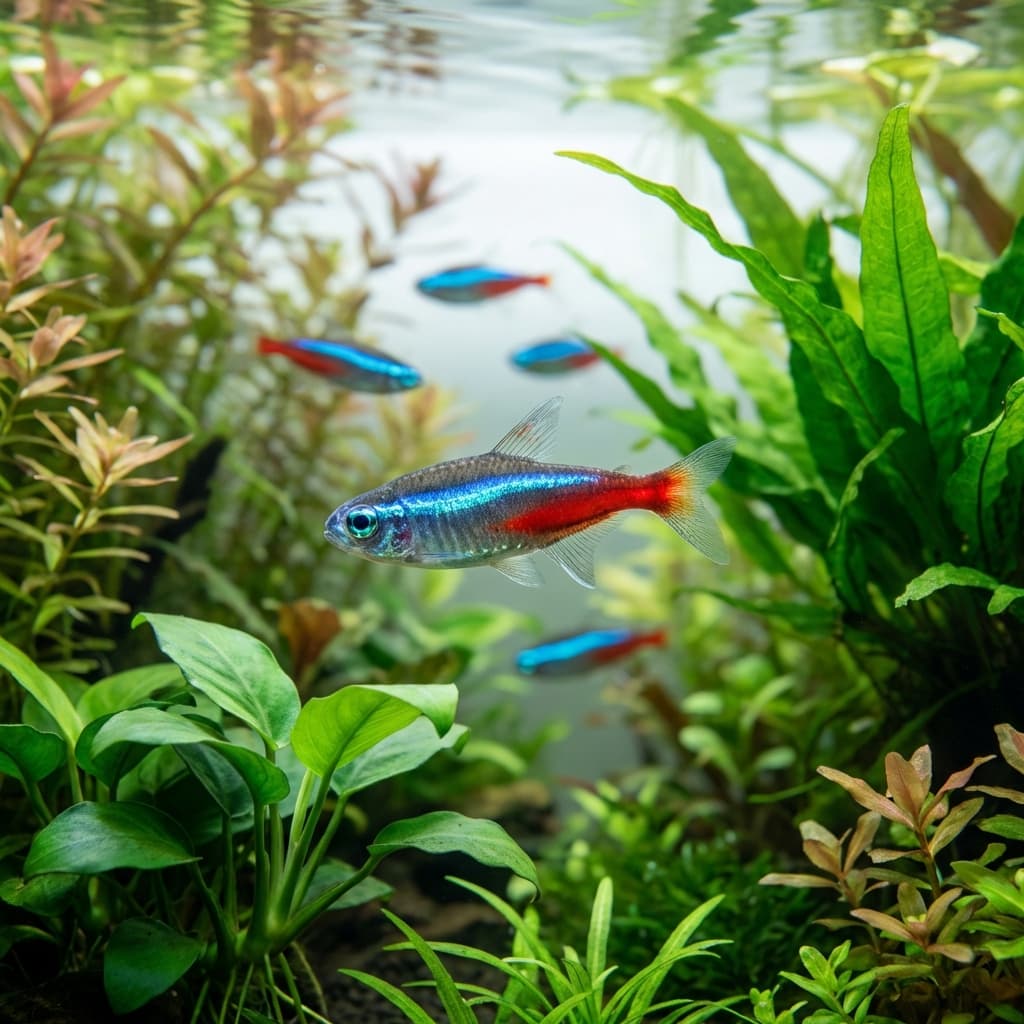
The coloration is extraordinary: a brilliant electric-blue horizontal stripe runs from the eye to the adipose fin along the upper flank, while the lower posterior body and caudal area is brilliant red-orange. The anterior body is silver-translucent, and the combination creates an almost luminescent appearance, particularly in dim lighting. Males are slightly slimmer; females are more rounded, and the blue stripe appears slightly bent at the center where the rounder belly creates a slight curve.
In the wild, P. innesi forms enormous schools numbering in the thousands, sweeping through blackwater forest streams in coordinated formations. This mass schooling behavior serves as the primary anti-predator defense — the collective flickering of electric blue stripes confuses predators.
Despite their fragile, delicate appearance, captive-bred Neon Tetras are considerably hardier than their wild ancestors and adapt well to a range of aquarium conditions. However, they are susceptible to 'Neon Tetra Disease' (caused by the microsporidian parasite Pleistophora hyphessobryconis) — a serious and usually fatal condition with no cure, emphasizing the importance of quarantining new fish.
Care Guide
Neon Tetras adapt to pH 5.5–7.5, hardness 1–10 dGH, and temperatures 20–26°C. Soft, slightly acidic water with tannin content produces the most vivid coloration. Standard community tank conditions with good filtration and regular water changes are suitable for captive-bred specimens.
A minimum 60-liter planted aquarium suits a group of 12–15. Provide dark substrate, driftwood, Indian almond leaves, and dense fine-leaved plantings. Moderate gentle current or still water. Open mid-water swimming space allows natural schooling. Subdued lighting or floating plants make the electric-blue stripe glow most vividly.
Feed quality micro-flake, micro pellets, and regular live or frozen foods: daphnia, baby brine shrimp, cyclops, and micro worms. They are enthusiastic feeders that accept most standard aquarium foods.
Neon Tetras are entirely peaceful and suitable with virtually all community species: corydoras, small catfish, small gouramis, livebearers, rasboras, and most peaceful dwarf cichlids. Avoid large fish that may consume them, or aggressive fin-nippers.
Keep in groups of at least 10, with 15–20+ being ideal for impressive schooling. Quarantine all new specimens for 4+ weeks before introduction to observe for Neon Tetra Disease. Weekly water changes of 25–30% maintain water quality.
Buy Neon Tetra (Paracheirodon innesi) from FinsHQ shops
Shops currently listing this species with stock available
Sell Neon Tetra (Paracheirodon innesi) in your shop?
Join aquarium shops already using FinsHQ. Get a beautiful webshop, mobile app, and inventory management — built for aquatic retailers.
Start your free store