
Platinum Angelfish (Pterophyllum scalare var.)
Pterophyllum scalare var.
Also known as: Platinum Angelfish, White Angelfish, Ghost Angelfish
Origin: Ornamental variant of Pterophyllum scalare — wild form from Amazon basin, Peru, Colombia, Brazil
Water Parameters
Quick Stats
- Max Size
- 15 cm
- Min Tank
- 150 L
- Lifespan
- 8-15
- Swimming Level
- MIDDLE
- Schooling
- No
- Diet
- Omnivore — flake, angelfish pellets, bloodworms, brine shrimp, daphnia, earthworms
- Temperament
- Peaceful; territorial during breeding; will consume very small fish; fin-nip sensitive
About
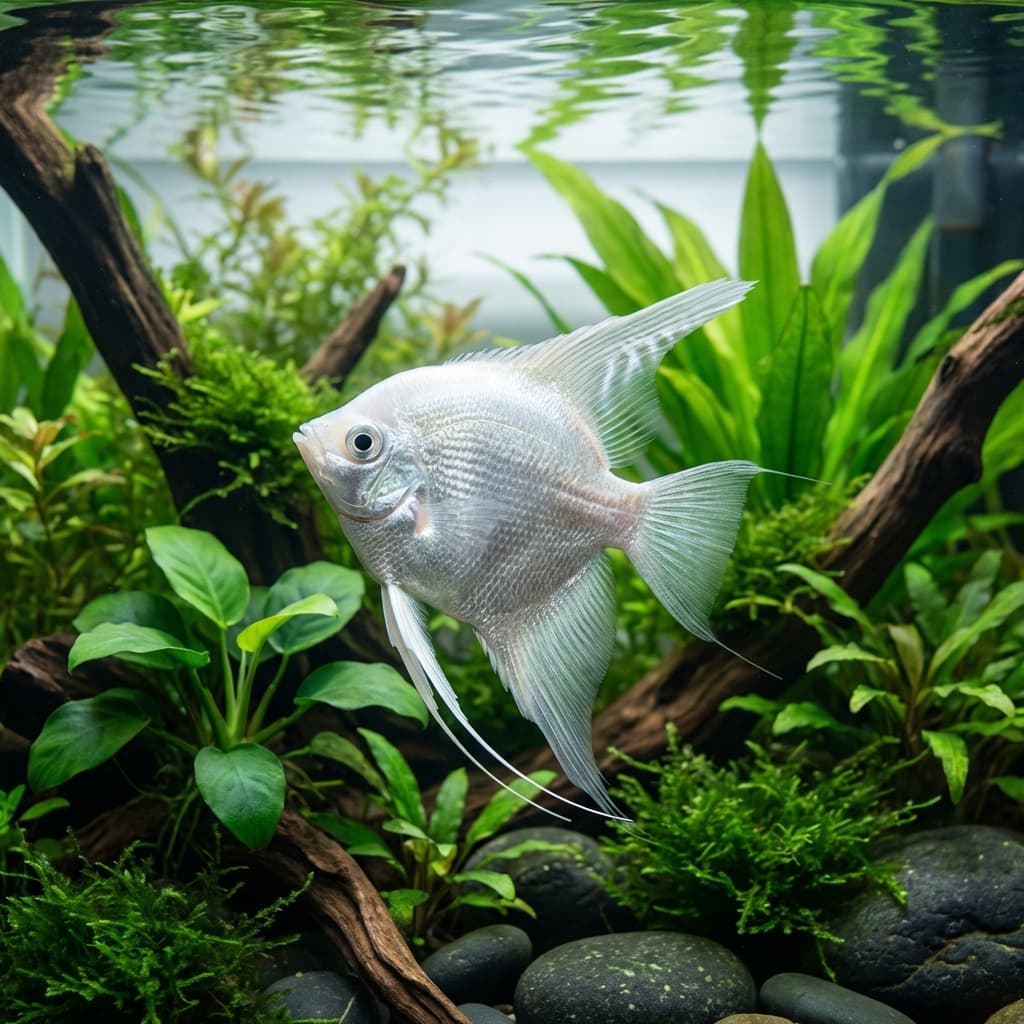
The Platinum Angelfish is a selectively bred variety of Pterophyllum scalare — the most widely kept ornamental cichlid in the aquarium hobby — produced through selective breeding for a recessive gene that eliminates all dark pigmentation from the body, resulting in a uniform pearl-white to platinum-silver coloration across the body, fins, and head.
P. scalare is native to the Amazon River basin across Peru, Colombia, and Brazil, inhabiting slow-moving, vegetated water with dense aquatic plant growth and abundant driftwood. From this wild stock, decades of selective breeding have produced dozens of color and fin variants including marble, koi, blushing, black, blue, zebra, ghost, and many others — the Platinum being one of the most striking.
The Platinum Angelfish retains the characteristic angelfish form: laterally compressed, deep-bodied with dramatically elongated dorsal and ventral fins, triangular body shape, and long pelvic fin extensions. The pale white-platinum body makes the large, expressive eyes particularly prominent.
Despite their delicate appearance, captive-bred angelfish are reasonably hardy and adaptable. They are bi-parental substrate spawners that form devoted pair bonds and provide impressive parental care.
Care Guide
Platinum Angelfish share the same care requirements as all P. scalare varieties: pH 6.0–7.5, hardness 3–12 dGH, and temperatures 24–28°C. Captive-bred specimens are moderately adaptable to standard aquarium conditions, though soft, slightly acidic water is preferred.
A minimum 150-liter tall aquarium (minimum 50 cm height for adult fin extensions) is recommended. Provide tall, robust plants (Vallisneria, Amazon swords, Echinodorus), flat stones or slate for spawning, and driftwood for cover. Dense plantings with open central swimming space.
Feed quality flake food, angelfish pellets, and regular live or frozen supplements: bloodworms, brine shrimp, daphnia, and small earthworms. Two to three feedings daily in appropriate amounts.
Angelfishes are peaceful with most fish but may consume very small fish (nano species, small fry). Compatible with medium tetras (avoid very small species), corydoras, catfish, peaceful dwarf cichlids, and livebearers. Avoid nippy species (tiger barbs, serpae tetras) that bite angelfish fins.
During breeding, pairs become territorial around the spawning site. Maintain multiple species in the tank to distribute territorial aggression. Water changes of 25–30% weekly promote health and trigger spawning behavior.
Buy Platinum Angelfish (Pterophyllum scalare var.) from FinsHQ shops
Shops currently listing this species with stock available
Sell Platinum Angelfish (Pterophyllum scalare var.) in your shop?
Join aquarium shops already using FinsHQ. Get a beautiful webshop, mobile app, and inventory management — built for aquatic retailers.
Start your free store