
Zig Zag Eel (Mastacembelus armatus)
Mastacembelus armatus
Also known as: Zig Zag Eel, Tire Track Eel, Marbled Spiny Eel
Origin: South/Southeast Asia (India, Sri Lanka, Mekong basin, Thailand, Vietnam, Indonesia)
Water Parameters
Quick Stats
- Max Size
- 90 cm
- Min Tank
- 300 L
- Lifespan
- 10–18
- Swimming Level
- Bottom
- Schooling
- No
- Diet
- Carnivore
- Temperament
- Peaceful toward large fish; will eat small fish — keep only with large, robust tankmates
About
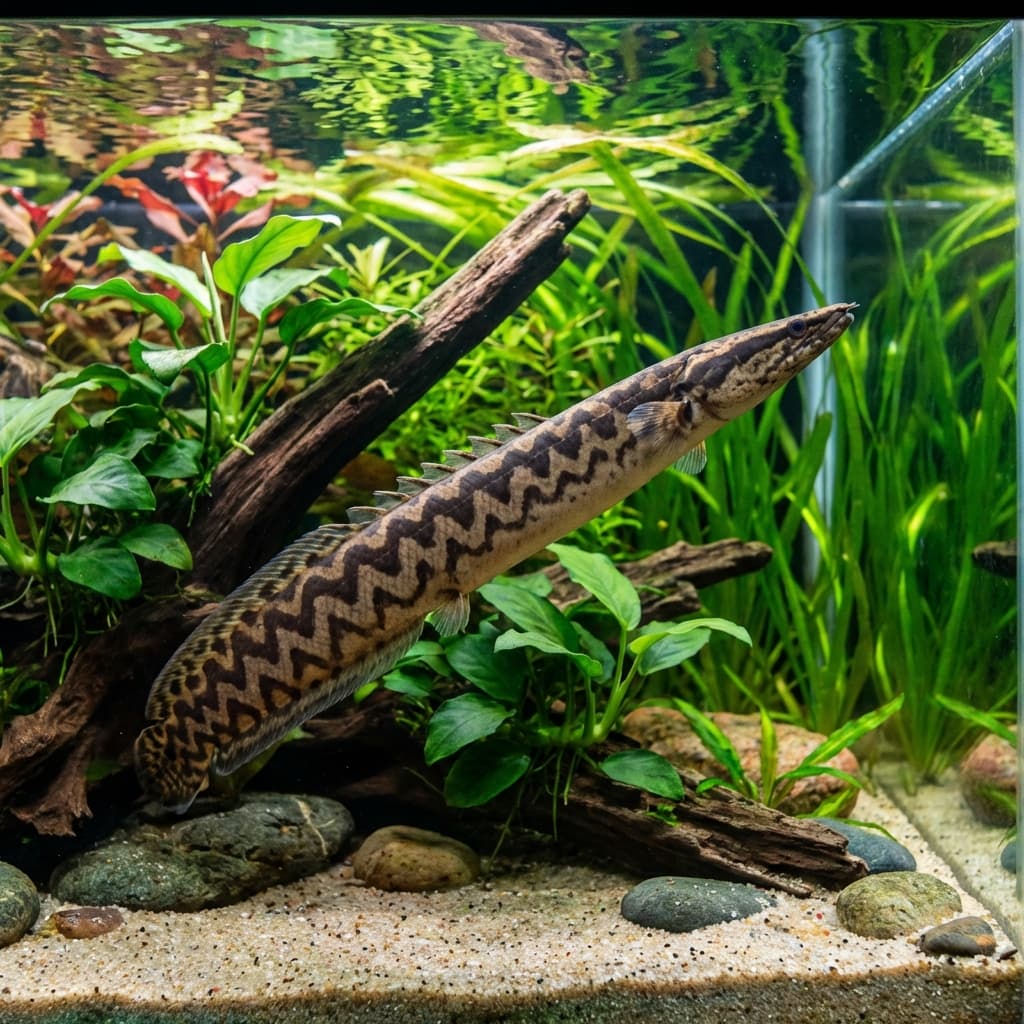
The Zig Zag Eel (Mastacembelus armatus), also known as the Tire Track Eel or Marbled Spiny Eel, is a large and striking freshwater spiny eel from rivers and streams across South and Southeast Asia — from India and Sri Lanka through the Mekong basin, Thailand, Vietnam, and Indonesia. Its body is a complex mosaic of cream, tan, and dark brown zigzag and reticulated markings, creating its common 'tire track' or 'zig zag' appearance.
Spiny eels are not true eels but belong to the order Synbranchiformes. They are bottom-dwelling, burrowing fish that spend much of the day hidden in substrate or wedged under driftwood and rocks, becoming more active and feeding at night. In the aquarium, a deep, soft sand substrate (10+ cm) is essential to allow their natural burrowing behavior and prevent injury.
Mastacembelus armatus grows to 90 cm in the wild (typically 40–60 cm in aquariums), making it a significant commitment in terms of tank size. It is an ambush predator that feeds on earthworms, small fish, crustaceans, and invertebrates. Introducing it to prepared foods (frozen bloodworm, frozen prawns, earthworms) requires patience — live foods are often needed initially.
Despite its predatory nature and large size, the Zig Zag Eel is peaceful toward fish too large to eat. It can be kept in large community aquariums with appropriately-sized robust tankmates.
Care Guide
Water Parameters: pH 6.5–7.5, temperature 24–28°C, GH 5–15. Clean, well-filtered water with moderate current is important. Excellent filtration is necessary given the heavy bioload of a large specimen. Weekly water changes of 30–40%.
Tank Setup: Minimum 300 liters for a single adult. DEEP SAND SUBSTRATE (10–15 cm minimum) is essential for burrowing behavior — without it they become stressed and refuse to settle. Large driftwood, caves, and overhangs for shelter. Tight-fitting, weighted lid is mandatory — they are escape artists that can squeeze through very small gaps.
Feeding: Primarily carnivore. Offer earthworms, frozen prawns, frozen bloodworm, mussels, and fresh fish. Initially may require live foods to trigger feeding. Wean onto frozen foods with patience. Feed every 2–3 days — large meals less frequently. Remove uneaten food promptly.
Tankmates: Peaceful toward fish too large to eat. Keep only with large, robust fish: large cichlids, large catfish, large barbs. Avoid anything smaller than 10 cm. Keep singly or in large tanks with only one specimen — can be territorial toward own species.
Health: Sensitive to poor water quality and medication (loach-like sensitivity). Use half-dose of medications or spiny-eel-safe treatments only. Common health issues include bacterial skin infections and internal parasites. Ensure deep sand substrate at all times.
Buy Zig Zag Eel (Mastacembelus armatus) from FinsHQ shops
Shops currently listing this species with stock available
Sell Zig Zag Eel (Mastacembelus armatus) in your shop?
Join aquarium shops already using FinsHQ. Get a beautiful webshop, mobile app, and inventory management — built for aquatic retailers.
Start your free store