
Bucephalandra Green Wavy
Bucephalandra sp.
Also known as: Bucephalandra Green Wavy, Buce Green Wavy
Origin: Southeast Asia (Borneo)
Care Requirements
Quick Stats
- Placement
- Foreground / Midground
- Growth Rate
- Slow
- Height
- up to 15 cm
- Propagation
- Rhizome division
- Notes
- Rare collector's plant
About
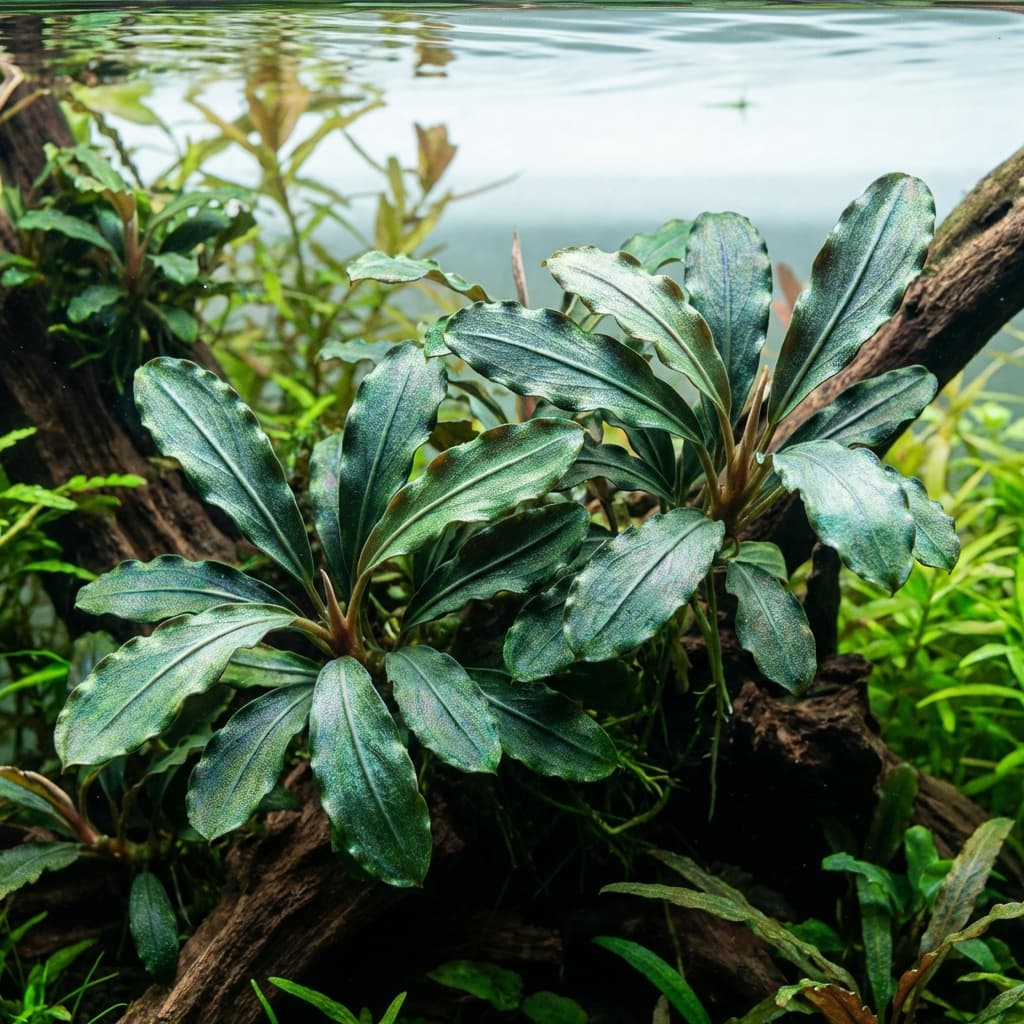
Bucephalandra sp. 'Green Wavy' is one of the many highly coveted Bucephalandra varieties originating from the island of Borneo, particularly from the fast-moving streams and rivers of Sarawak. As a rheophyte — a plant adapted to grow submerged in flowing water attached to rocks — Bucephalandra does not root into substrate but anchors via rhizoids to hardscape surfaces such as driftwood and stone. Its leaves are small, elliptical to lance-shaped with distinctly wavy margins, and display a rich green color with a characteristic iridescent shimmer that reveals blue-green or teal hues under bright lighting or at certain angles. This iridescence is created by specialized cell structures within the leaf surface and is one of Bucephalandra's most enchanting qualities. Like all Bucephalandra varieties, Green Wavy is a slow grower, producing new leaves at a rate of one to two per month under optimal conditions. Despite slow growth, it is long-lived and accumulates into substantial, beautiful clusters over time. It is particularly popular in shrimp-focused aquariums and high-clarity Dutch or nature-style tanks where its distinctive appearance stands out against mosses and other plants. Bucephalandra is relatively sensitive to sudden parameter changes, which can cause leaf melt similar to crypts, though it recovers reliably. CO2 and regular micronutrient dosing significantly improve growth rate and iridescence intensity.
Care Guide
Placement and Attachment Attach to driftwood, rock, or ceramic substrate using gel glue or cotton thread. Do not bury the rhizome in substrate — this causes rot. Position in areas with gentle to moderate water flow, which simulates its natural riverine habitat.
Lighting Low to moderate light (15–35 µmol/m²/s PAR) is ideal. Iridescent shimmer is most visible under LED lighting with a good spectral spread. Avoid intense light without CO2, which increases algae risk on slow-growing leaves.
CO2 and Fertilization CO2 injection at 20–30 ppm significantly improves growth speed and leaf iridescence. Dose micronutrient-rich liquid fertilizer weekly. Iron availability enhances leaf color depth.
Water Conditions Prefers pH 5.0–7.5, temperature 22–28°C. Soft, slightly acidic water produces the best results. Sudden large water changes can trigger leaf melt — make changes gradually.
Leaf Melt Management Leaf die-back after introduction or water chemistry change is possible. Remove melted leaves; the rhizome recovers reliably. Maintain stable parameters to prevent recurrence.
Propagation Divide the rhizome once 3–5 leaves are visible on a side shoot. Re-attach divided portions to hardscape. Growth is slow, so propagation takes patience.
Common Issues Slow growth under suboptimal conditions is expected. Algae on leaves (due to slow growth rate) is the main concern — ensure excellent water quality and balanced nutrients.
Buy Bucephalandra Green Wavy from FinsHQ shops
Shops currently listing this plant with stock available
Sell Bucephalandra Green Wavy in your shop?
Join aquarium shops already using FinsHQ. Get a beautiful webshop, mobile app, and inventory management — built for aquatic retailers.
Start your free store